Saturday, 31 January 2009

South Downs Way Day One Winchester - West Meon

It’s been a good many years since I walked the South Downs Way – in fact apart from a reacquantaince with the Lewes-Eastbourne stretch in the mid 1990s I hadn’t walked most of it since I last competed in the Downsman Hike of 1989. Since then another 20 miles has been added to the beginning of the hike, meaning that a sizable chunk now crosses Hampshire as well as Sussex. Given that it has been almost twenty years and a number of route changes have taken place improving the whole route, I thought it was high time to give it another try.

Most guidebooks suggest that the first stage of the walk should be to Exton, a village a couple of miles to the south of West Meon, but for the day walker there is no contest as there is a direct bus service between West Meon and Winchester. This makes for an easy public transport connection between the two, which is only enjoyed a couple of times a day from Exton. By now it was the end of January, really the earliest I like to get out walking. The days are getting a little longer and I had the rare luxury of a lovely sunny day, perfect for walking.

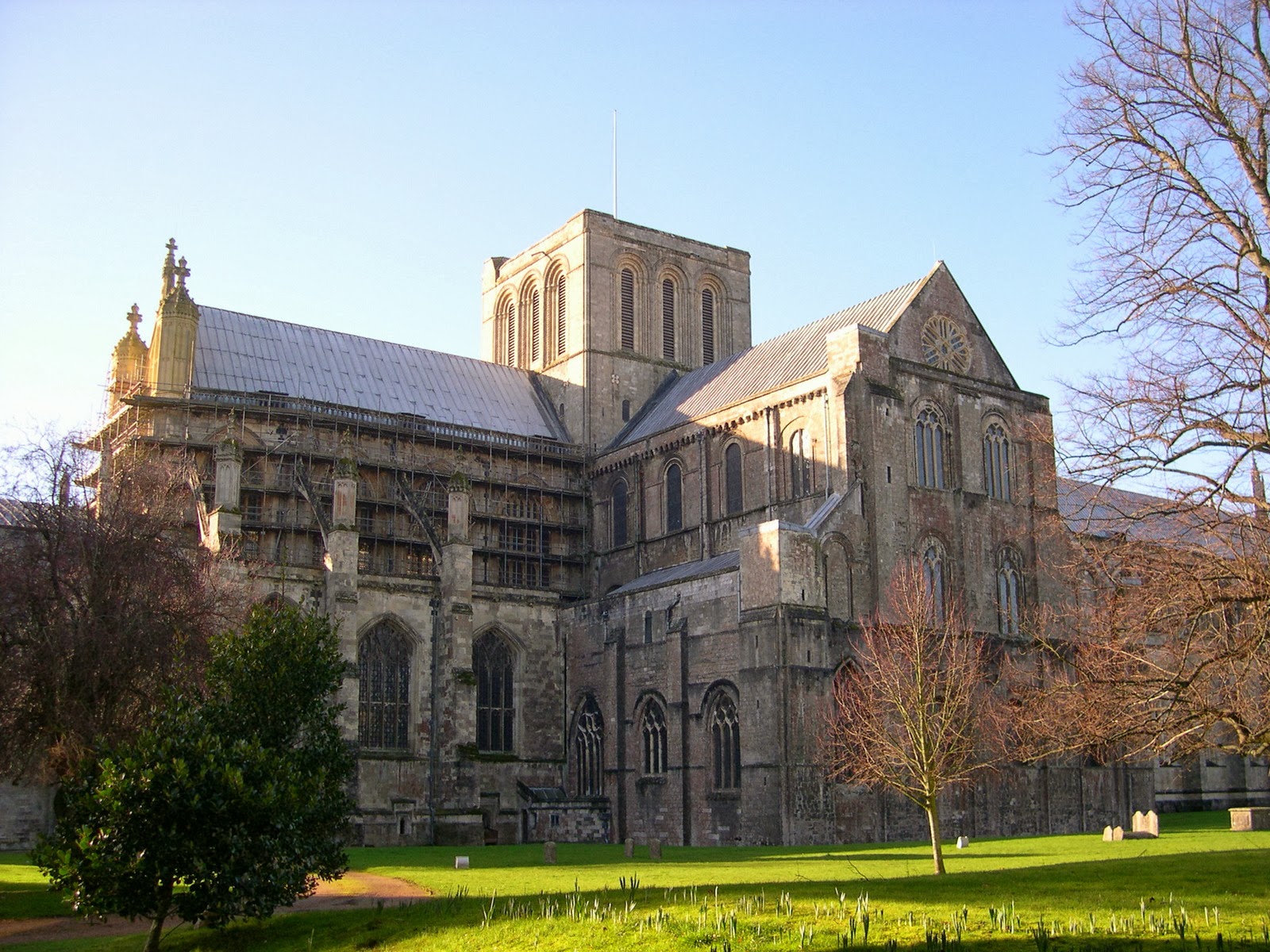
Before getting started on the trail I took a few minutes to have a look around at what Winchester had to offer. The path proper starts from Winchester Town Hall, a beautiful church like municipal building that dominates the street. Behind the Town Hall lies the cathedral with its slightly squat tower. It positively gleamed in the low winter sun and all around the precincts daffodils were in advance stages of growing, with flowering only a week or two away. Just along the road and perhaps the de facto start of the trail was a large statue to perhaps Winchester’s most famous resident, Alfred the Great, who was King when Winchester was the capital of all England.

I followed the path as it left Winchester, going along by some old timber framed buildings and across what was clearly an old railway line, long since defunct but still clearly visible even though part of it had been turned into a road and car park. The path then turned sharply up the hill and out along a very attractive suburban road towards the M3. The motorway was an unwelcome intrusion on the landscape but today was fairly quiet. The roar of what traffic was about though could be heard for a couple of miles.

Once across the motorway the path headed into the countryside along the edge of a field which seemed to last for some time until getting to the small village of Chilcomb. At this point it was surprising how many daffodils were already blooming, some five weeks before the time I would traditionally think of them. I didn’t get to see much of Chilcomb as the path rather detoured around what I assumed was the central part of the village (which I don’t think amounted to much).

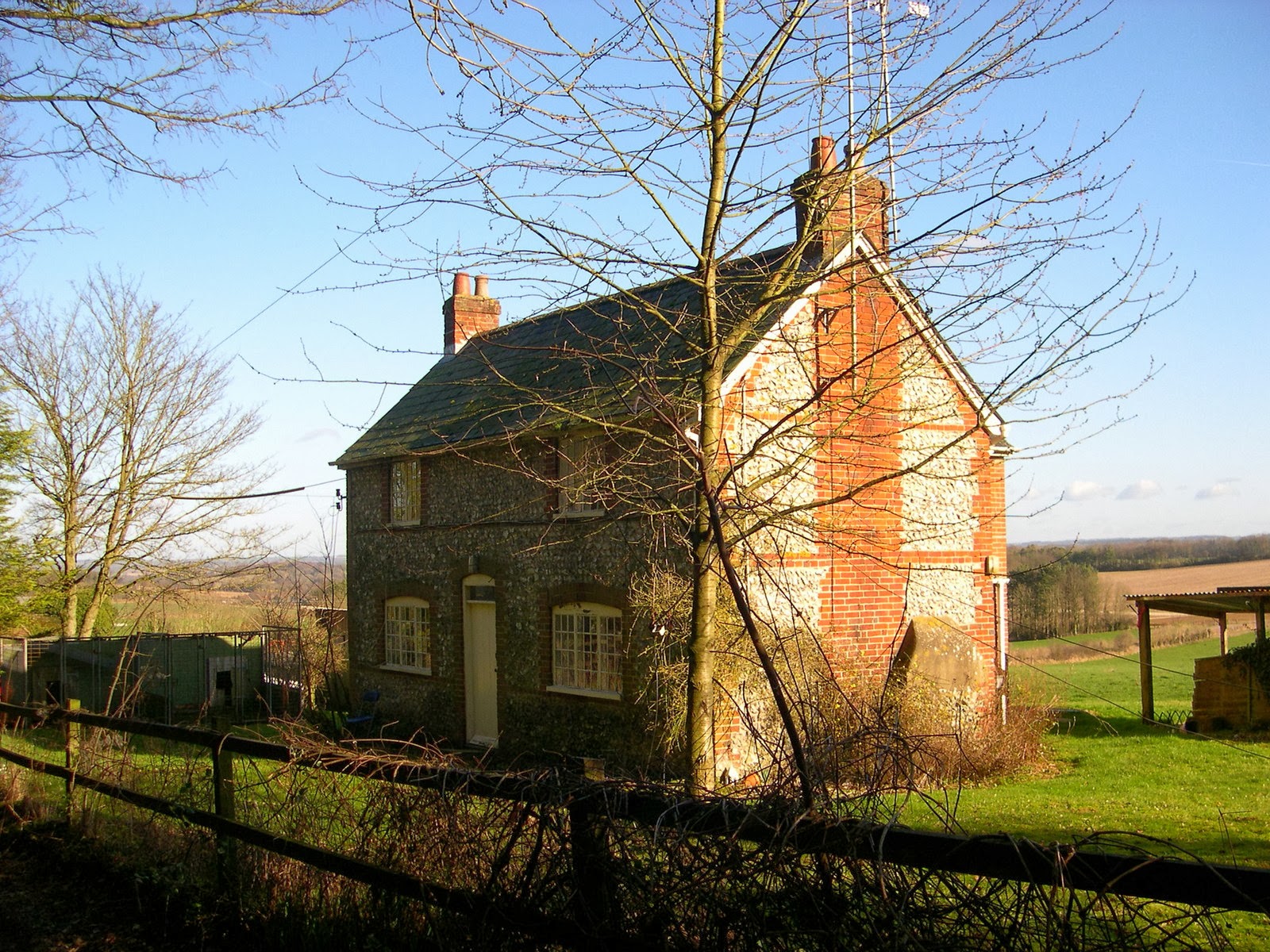
From Chilcomb the path started climbing up on to the ridge of the downs, slowly at first but with a short steep section at the end. At the top was the edge of a shooting range, which today was off-limits as the red flag was limply flying. Adjacent was a very attractive cottage with a garden full of crocuses. Although I assumed I was at the top of the hill, when I got round the corner I soon realised that I had a bit more climbing left to do to get to the top of Cheesefoot Head.

After climbing for some time the view all around me began to unfurl and what a view it was. To the north I could see the Science Centre and its unusual pyramid shape with views across to North Hampshire and the Wessex Downs beyond. Behind me was Winchester, dominated by the Cathedral and a rather ugly square looking sixties tower block (rather unfortunate!). To the South was the Hampshire coast and the Isle Of Wight. The view was staggering on the clearest of days imaginable.
When I got to the top of Cheesefoot Head, the mud started. I had an interesting time trying to stay out of the mud which was extremely sticky. I managed to stay upright despite the slipperiness for some time before failing not long after crossing the main road and falling in a muddy heap. It was a pity this section was ruined by the mud as this was the only true ridge of the day. I recovered my composure and the mud eased as I entered a very beautiful beech wood. The light shining through the trees was almost unreal, with a slightly watery golden colour.

After half a mile or so of woodland walking it was back out into open countryside and past a small farm where I turned right back towards the A272 that I had crossed at Cheesefoot Head. I found myself a piece of farm machinery that meant that I did not have to sit in the mud to eat my lunch but had a dry seat instead. After a welcome break I continued across fields to find the first lambing activity of the spring going on. My first clue was the seemingly endless line of sheep coming towards me from a large scrum going on at the top of the hill ahead of me. I couldn’t quite decide what was going on at first but soon realised that the melee of sheep were having their scans to make sure their babies were healthy. It was a fascinating process with sheep, dogs and people all very focused on the task ahead.

I passed through another farm and then the path seemed to follow a number of roads for a while. These were pretty quiet luckily and a welcome respite from the mud although in a strange way they also sapped my energy due to the pounding of my feet on the hard surface. I passed the Millburys public house, which didn’t seem to be open before heading out along another really muddy track. I passed Lomer Pond and could just about make out the outlines of the plots of the old houses of Lomer village, long since lost to the sands of time (I think a victim of the Black Death, like so many other villages at that time). I returned to the road after half an hour of boggy conditions until reaching Beacon Hill nature reserve. Because of my public transport requirements I took the bridle path alternative route here rather than carry on to Exton village.

The path weaved its way down through the trees to Warnford village and after a few minutes I was able to admire the view of the Meon Valley stretching away from me. As I walked down through the field I was followed by the sheep, a rather disconcerting experience. It was as if the sheep were attempting to herd me away from their territory.

At Warnford village I passed a watercress field, a feature for which this part of Hampshire is famous. To my untrained eye it looked pretty well advanced for being so early in the year. I didn’t hang around, pushing on to the old railway line just outside the village. At this point the railway was in a deep cutting so I had to scramble down to gain the path that now passes where the rails once were. I continued to the site of West Meon station along a fairly unremarkable piece of disused railway line. There wasn’t much left of the station, but the old platforms were clearly visible through rather dense vegetation. Shortly after the station, the track abruptly stopped since the old viaduct that used to cross the River Meon had long since been removed.

I headed into the village, famous for two residents; Thomas Lord who founded the Lord’s Cricket Ground, and Guy Burgess, one of the Soviet spies from the 1950s. Otherwise West Meon appears to have little excitement about it, although undoubtedly a very attractive village that would be a joy to live in.

See more pictures at my Flikr site - click on the title to view

Friday, 30 January 2009

Saxon Shore Way Day 10 Rye - Hastings


Now we reach the climax of the walk and there are two distinct halves with the first being a low-level walk before the rollercoaster of the cliffs between Fairlight and Hastings. The walk into Hastings is one of the most memorable final stretches to any walk I have taken and is a fitting conclusion to this historical stretch of coastline.

Unusually this section of the walk may best be done on a Sunday, since you will get free parking at Hastings station and the frequency of the Hastings – Ashford Service is actually the same every day of the week (hourly). Hastings station has been completely rebuilt and is now a very modern facility with trains to match. The grotty old trains that used to ply this almost forgotten link across Romney Marsh are now a thing of the past and the new trains are very much in keeping with the new image of the railways.

I undertook this section on a cold and snowy day but the weather actually posed few problems even on the cliff-top section. As I had a proper visit of Rye on the previous section of the walk I headed straight out of town and past the famous smock windmill. The path then heads across towards Camber Castle, designed along similar lines to those passed earlier in the walk at Sandown, Deal and Walmer and built during the reign of Henry VIII to fend off the French. This particular castle was rendered useless fairly quickly due to the shifting coastline in the area, which meant that it was landlocked within a few years of being built. However, it is almost a complete shell unlike Sandown Castle. It doesn’t appear to be much of a tourist attraction though, with access to the site being very limited.

Shortly afterwards the path meets up with the Royal Military Canal once again, just at the foot of the hill upon which Winchelsea is built. This was a planned medieval town and was once a major port, although its maritime life was fairly short-lived due to the old enemy of silting and it is now over a mile from the sea. The path doesn’t visit this small town, although a quick look is thoroughly recommended if you have time, but follows the canal to the western entrance to the sea.

In keeping with the sections across Romney Marsh, this is a fairly desolate area of countryside and was the scene of a number of snow showers as I walked it, adding to its atmosphere. The old shoreline is clearly visible particularly on the early part and it is a little strange to think that where you now walk used to be under seawater. Eventually you reach Cliff End (another one!) and pass the houses largely built during the 1930’s along this lonely coast. One notable exception is the large box-like modern house, which you may remember from the TV programme ‘Grand Designs’ a few years ago.

From here on, the path has a completely different character as it climbs up on to the cliffs at Fairlight. Initially as you look back through the trees you will see the last view across the Marsh and Dungeness. Once over the first of the cliffs, the only real views are out to sea and the path ahead. What the map doesn’t prepare you for on this section is the rollercoaster nature of the terrain. Unlike earlier clifftop sections, this is not a nice level section but rather tough going in places, especially today with a very slick surface caused by the snow showers. Although this is undoubtedly amongst the best scenery on the whole route, the slog up and down the various coves was a bit of a shock to the system and I groaned more than once as I saw another steep valley to cross.

Eventually you come to Hastings Country Park, a wide and airy grassy expanse at the top of the cliff overlooking the Old Town of Hastings. The view from this point westwards was amazing, with almost the whole of the southern part of East Sussex visible on this clearest of afternoons. Eastbourne could clearly be seen in the distance and from there the line of the downs could be followed all the way to Lewes, with Firle Beacon and Mount Caburn on the horizon almost thirty miles away. The town of Hastings looked at its best from up here, with the maze of the old buildings and fishermen’s huts clogging up the narrow valley just below me.

I decided to cheat slightly and took the cliff railway down to the seafront to save me about twenty minutes walk. This was a very pleasurable way of finishing the walk and from here it was a short stroll to the train station to meet up with my car.

Thursday, 29 January 2009

Saxon Shore Way Day 9 Ham Street - Rye

It was now 1st September and I hadn’t been out for a couple of months due to the hot weather. Today was a greyish sort of day, much cooler than recent days and a perfect one for walking, although perhaps not for picture taking. I was by now only half way through the scheduled number of days required to complete the hike and this appeared to be the shortest section left on paper so I thought for that reason I would do this today so that I could limber up a bit before the longer sections to come later in the autumn.

Ham Street was a village by now well known to me. It was my third visit in a year, and a very convenient staging post thanks to its station. This time I would be heading vaguely south west on my walk and across a much bleaker part of Romney Marsh. The first part of the walk involved traversing some fairly uninteresting fields to Appledore. The only places of notes on the way were Warehone Church and Kenardington Church, two fairly lonely churches deep within the rolling countryside that marks the area to the north of the Military Canal visited in the last section. There was also a large mound of earth, that although not marked on the map could easily be a burial mound.

Appledore is a very pleasant village, strung out along a marshland road. On this early September day, it was fairly dead and this added to its air of remoteness from the rest of civilisation. I left the village via the old Mill Hill, where although the windmill had long since disappeared, the earthworks required to obtain some height above the flat lands below were still clearly visible.

From here the path joined the side of the Reading Sewer, one of the many drainage ditches that I would be following today. Still surprisingly lush despite the lateness of the season, every now and again the sun tried to pick out some of the attractive underwater plants. It was a contrast to the now empty fields that had had most of their crops removed following harvest time. The path crossed Reading Sewer at Oxney Bridge, a real old relic that replaced an earlier ferry. In fact the tariff for the ferry was still posted on the adjacent pub (called The Ferry, a huge hint perhaps?)

Shortly after the path took a right angled turn and headed south towards the small village of Stone-in-Oxney. The isle of Oxney is no longer an island of course, with the river that caused it to be an island being diverted some five miles to the south. However, this area of land still gives the impression of being an island for it is a definite hill among a huge area of flatness. If you trace the contours around in this area it is still possible to imagine that this was once an estuary. The path continues over the hill at Stone and past the very attractive church at the top, presumably sited to ensure that it never flooded.

At the top of the hill it is possible to make out the old cliffline once again and ahead Rye comes into view for the first time. The path immediately drops down the other side and at the bottom of the hill the path meets the Royal Military Canal once again and continues along its side for the rest of the journey into Rye. On the whole this is a fairly uninteresting section of walk, but is punctuated by a couple of features. The path crosses from Kent into East Sussex and as it does so, merges with the Sussex Border Path, a long distance hike that follows the whole border from the far end of West Sussex to this point. Once at river/ canal level there is little to see apart from the town of Rye looming in the distance and dominated by St Mary’s Church at the very top of the hill. Over in the distance the Pontin’s holiday camp at Camber Sands is a slightly incongruous sight, but otherwise the scene is very much of human attempts to drain the landscape through various channels and locks.

Rye itself is a very attractive old historic town and train timetables allowed me to spend some time there soaking up a little of the atmosphere. By now it was lunchtime and so I availed myself. Typically the weather had perked up considerably by now and the cloud of the morning had largely disappeared. Rye was a very interesting conclusion to a fairly disappointing section of the walk, with few memorable features, no sea and uninteresting terrain. The atmosphere of this side of the marsh was a lot more remote feeling than the last section. It did prove to be a relatively easy section to get back into the swing of walking ready for the autumn season.

Wednesday, 28 January 2009

Saxon Shore Way Day 8 Sandling - Ham Street


OK this is where it gets confusing folks. As you will recall I finished the last section in December, but actually the next section was walked in the previous May! It was all part of my cunning plan to try and get the most of the seasons at each section along the way.

It was a very pleasant May day and due to the relatively small amount of time at my disposal I decided to tackle this stretch as the third of the ten parts of the walk, rather than the much longer section near the Medway towns. As it was the height of spring I selected this section as an inland part of the walk that would enable me to take advantage of the spring flowers.

I was not disappointed as almost immediately the path passed into Chesterfield Woods, which were still carpeted in bluebells, almost a month after my last outing in North Kent where I had seen the first ones of the year. Once out of the woods the path then crossed to Pedlinge, a small hamlet on the Sandling road. The focus of the hamlet appeared to be a farm, which had a very attractive pond at its heart.

Unfortunately the next mile of the walk was very disappointing, crossing some fairly uninspiring fields that potentially were being left fallow for the year. Eventually I reached another road at Shepway Cross, a monument to the Cinque Ports. From here was a fantastic view right across Romney Marsh, today covered in yellow as the rapeseed fields were in full flush. Looking across to the nuclear power station at Dungeness almost twenty miles away it was hard to believe that this whole area before me was covered in seawater about one thousand years ago.

A few more metres along the road and the path left the road and continued along the crest of the ridge and round past St Stephen’s Church and Lympne castle. This may have been a replacement for Stutfall Castle, a little further on. This structure had been carried down the hill by a number of landslides over the years, leaving just broken walls and rubble. A little further along the old cliffline was a very odd sight, when I was confronted by a group of wolves! Luckily these looked to be very lazy beasts and were safely contained behind a very large fence. This was one of the outer edges of Port Lympne Zoo and as I continued on my way I also got to see giraffes and ostritches. One feature of walking in midweek is that I rarely get to meet anyone on my way, but I did bump into a fellow walker at this point and found that she too was doing the Saxon Shore Way, a rarity I would think.

The path dropped off the top of the old cliffline and down to the Royal Military Canal. This was presumably built to provide safe passage for boats without having to circumnavigate Dungeness and run the gauntlet of naval vessels during various skirmishes between England and France. All was quiet now, and much of the canal has been taken over by pond plants, precluding any further use until a great deal of clearance.

The path continued along the side of the canal for about a mile. The May blossom was now in full swing and everywhere looked really lush in the bright sunlight. By now the weather was warming up a bit too and when I left the canal side and returned to the top of the old cliffline I really felt very hot. I actually felt a little self conscious as I was watched all the way by the sheep in the fields, although to be fair they were probably more concerned with the welfare of their lambs than my appearance. At the top of the hill the old cliffline was very apparent and I sat for a while and tried to imagine the water crashing against the foot of this hill during stormy weather. It wasn’t easy as the sea is now at least six miles distant at the nearest point.

The path turned away from the sea altogether and the next section of the walk was primarily a mixture of woodland and fields. All the trees were now sporting nice new foliage, which had sprouted in the last week or so. This was very striking against some dark skies with sunlight shining upon it. By now I could see that time was a little pressing so I got my skates on to try and make the earlier train from Ham Street. Very little diverted me from this cause, other than a rather stupid looking sheep that had got itself caught in a barbed wire fence. I went to help it, but I think all I succeed in doing was frightening it and so I decided to leave it be. Usually they break free from these little traps anyway.

Despite stepping up the pace and not worrying too much about photographs (there was little to photograph in the woods anyway!), it became clear by the time I got to Ham Street Woods that I wasn’t going to make it for my train. I did hear the horn of the train as it passed, so immediately dropped the pace as I knew I would have an hour’s wait for the next one. Ham Street Woods had a much different atmosphere from the last time I had been here in the autumn, when I completed the Greensand Way.
Now it was a bright spring day, with birds singing and dry underfoot. Then was a cold late afternoon, getting dark and completely silent. It made for a pleasant last part of the walk and I had plenty of time for resting before getting the train back to Ashford, where I had parked the car.

Tuesday, 27 January 2009

Saxon Shore Way Day 7 Dover - Sandling


I had decided upon this section as the last I would walk, partly as it promised to be one of the highlights of the whole route. In that respect I was not disappointed, with virtually the whole walk being at high level along the last stretch of the North Downs before it disappears into the sea at Dover. By now the walking season for the year was very much over and this turned out to be an unseasonably nice day for December. Of course being so late in the year and close to the winter solstice the daylight hours were in fairly short supply and the sun never really got high in the sky making light conditions quite strange.

I parked at Sandling station and took the train into Dover, a scenic run along the seawall at Shakespeare Cliff. The day wasn’t very promising with pretty gloomy conditions at first, in stark contrast to the completion of the last stage which had been at the height of summer. I climbed up on to Western Heights, yet another fortification to protect the country this time built during the Napoleonic Wars. Walking around the ramparts of the fort was very interesting and afforded some very good views of Dover, the castle on the opposite hill and the surrounding countryside. Down below the port was still very busy, presumably with plenty of day-trippers getting their Christmas shopping and plenty of lorries.

The path negotiated the fortifications and by-passed a young offenders institution before heading down the hill once again to the main Folkestone Road. Fortunately crossing this very busy dual carriageway was a lot easier than expected due to the presence of a subway crossing. From there the path headed for the cliff edge and for the next six miles or so the path hugged the cliffs. By now the weather was brightening up and it promised to be a very pleasant day. In contrast to my last foray along the coast path, the sea was like a millpond, very unusual for this time of year.

At the start of the cliff walk I turned to look back one last time at Dover port. One ferry was coming and another going and the train line below was also busy. The weak and watery sun shone down across the scene, making for a good picture. The next mile or so was a rollercoaster along the chalky cliffs, which made for fairly hard walking on the slippery chalky paths. While the scenery was very nice, the traffic noise from the adjacent A20 rather spoiled this section of the walk for me though. About half a mile along the cliffs I spotted a marker sign telling me how far it was to various points on the North Downs Way, a route that this section of the Saxon Shore Way shares.

The remains of various defence buildings were a feature of this section of the path. They included coastal lookouts, a concrete ‘radar’ dish and a rifle range, confirming that this has been the most heavily defended pieces of coastline in the UK over the past few hundred years. Below the cliffline, the coastline changed somewhat to reflect more recent attitudes towards our continental cousins. The cliffs no longer were the coast, since the coast had been built out with millions of tonnes of spoil from the Channel Tunnel workings to create a feature now known as Samphire Hoe. Further on still was a more natural feature had had a similar effect on the coastline; Folkestone Warren, a landslip that created a small strip of flat land between the cliffs and the sea. The effect of this has been to create a wooded hillside now that the cliffs are no longer eroded directly by the sea. The strip of land was exploited by the railway company and every so often far below me the sound of passing train horns would puncture the silence.

Just before Folkestone, the path passes by the Battle of Britain monument. This is a sobering reminder of the sacrifice of the World War II pilots that kept Britain from succumbing to German forces. On this quiet and sunny December day it was difficult to imagine the raging battles that took place overhead during 1940. Rather cleverly the monument was shaped like an aeroplane propeller, and in attendance were two of the non-living heroes of the hour, the Spitfire and the Hurricane.

Shortly after the monument, the path then veers away from the coast and continues along the line of the North Downs heading northwest through Kent. There were some very good views across Folkestone, although it was quite difficult to make out some of the details of the town as although by now it was midday, the sun had barely climbed above the horizon. This part of the downs was rather strange, since there wasn’t a ridge as such, but instead were a number of small solitary hills, quite unlike any other downland feature I have seen. The path continued along Crete Road and across a couple of main roads before coming across Caesars Camp, an iron-age hill fort overlooking the more modern features of the M20 and the vast expanse of the Channel Tunnel railhead. The view from the path looked down on the track as it enters the tunnel itself, with the main terminal away in the distance. As I passed a train made its way into the tunnel for the short trip to France, laden with lorries.

The path resumed a more usual route along the crest of the North Downs ridge for the next couple of miles, during which time there was plenty of opportunity to view the operations of the Channel Tunnel. It was interesting to contrast the rail activity with the sea activity from Dover port, even though both were fulfilling the same purpose of getting people from Britain to France. Just as a reminder to former days, the path passed by another pillbox as I made my way to Etchinghill. The ridge then came to an abrupt halt at Peene Quarry, where supposedly the chalk was quarried to construct Sandown Castle, passed earlier on the route through Deal. By now I was getting tired and my legs heavy as I contemplated the last few miles to Sandling. It wasn’t helped by conditions underfoot, which were quite heavy, thus slowing me down. A couple of the paths along the next stretch were particularly muddy, which required much picking my way through.

I was relieved when the path dropped off the downs and towards the village of Etchinghill. It was on this stretch that I met the first and as it turned out only person of the day, a lone female runner who was heading for the hills. The path itself never reached the village of Etchinghill, but passed under the old Folkestone-Canterbury railway line (formerly known as the Elham Valley line). Once across the road leading into the village the path regains the top of the ridge, passing an attractive beech wood that contained some rather odd looking shelters. There use became clearer when I got to the top of the hill and saw a notice advising walkers to take great care because of military exercises taking place periodically.

The path then rounded a very large antennae, presumably a television transmitter judging by its size, before finally leaving the North Downs for good and dropping down into the clay vale below. By now the light was fading a bit and as I looked along the surface of the grassy fields I could see that it was covered in cobwebs all catching the last of the day’s sunlight.

I took the last mile to Sandling station very slowly, partly because I still had plenty of time and partly because my legs felt like lead after dealing with heavy ground all day. The last part of the path took me across both the M20 and the Channel Tunnel Rail Link, both taking speeding traffic down to the Channel ports. I was glad to escape to Sandling woods, which was a nice quiet place in comparison. In the woods I passed by another former rail line, this time the old Sandling-Hythe route, long since closed.

By the time I reached my car, I felt pleased to have finished the Saxon Shore Way but despite the day’s walking being very pleasant and among the best of the days on the entire route, the end of the hike did seem to be an anti-climax and I couldn’t help thinking that Hastings really is a much more fitting place to finish.