Showing posts with label Velorail. Show all posts

Thursday, 3 December 2015

Velorail Des Andaines

Bagnoles De L'Orne
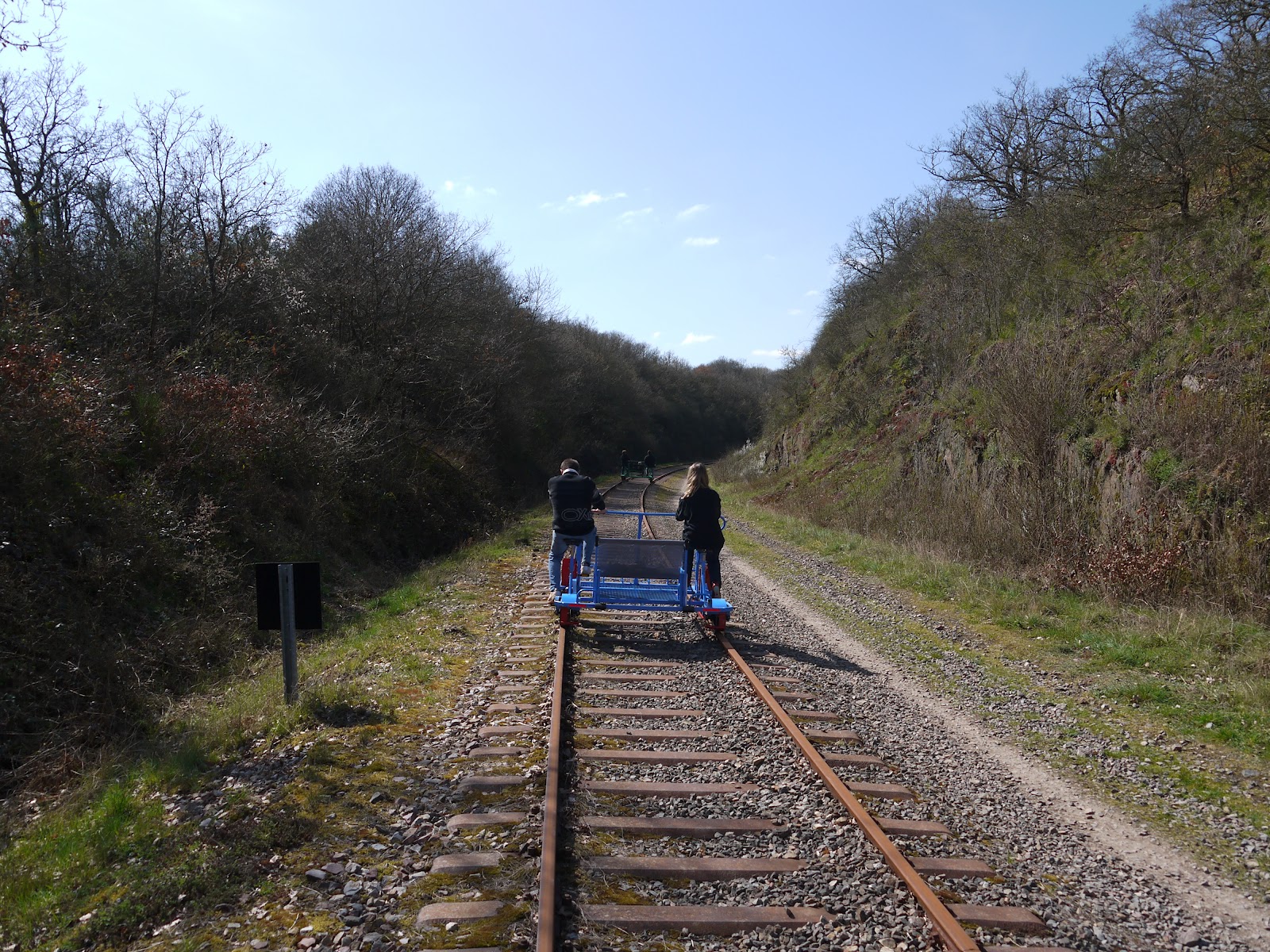
Whenever we go to France these days we try to look out for a velorail.  These operations are run on disused railway lines where the tracks have not been lifted and it is possible to use a specially adapted bike that takes up to four people.  There are a few such operations in Normandy and we have already tried the ones at Val de Maizet and Pont Erambourg.  A couple of others exist at Conde Sur Vire and Couterne but these weren’t open in October sadly.  We saw one at Bagnoles De L’Orne and weren’t sure whether it would be open as the website was a bit coy.  Nevertheless we thought we would try and if it wasn’t open we could still enjoy the scenery around this old spa town.

Autumn Colours

We arrived at the town shortly before lunch and it was immediately obvious that this town was rather different from others around the area.  It was grandly laid out for the type of discerning clientele you might expect of a place where people come to take the waters.  The railway station was still intact although trains have not run here since 1992 when the branch line from the nearby town La Ferte Mace closed down.  This would once have provided direct access from Bagnoles to Paris by train.  There was a sign up at the station suggesting that we would be in luck early in the afternoon and so we decided to have a look around town and head for a leisurely lunch first.
Bagnoles Hotel

Bagnoles is built around a beautiful lake, and this acts as the focal point of the town.  As it was now the zenith of autumn the colours of the trees were a fantastic palette of yellows, reds and browns.  Judging by the colours on show I rather suspect that the planting had been planned to ensure maximum impact.  Someone clearly had a lot of foresight!  The cloud had cleared just before we arrived to really add some extra colour by virtue of its golden light.  We wandered around the perimeter of the lake and then found ourselves a charming pizzeria/ galleteria for lunch.  Galletes are a sort of savoury pancake eaten in this part of Normandy and two of us had those while the others two had wood fired pizza.  It was delicious and feeling fortified we set off for the velorail to find that it was open for business.
Bagnoles Station

Bagnoles station is a two platform terminus that has clearly seen better days.  It wasn't always a terminus as a line continued on to the nearby village of Couterne but this appears to have closed in 1941, probably as a wartime measure that was never reversed.  Any trace of the onward line has disappeared I imagine under new development and the local road network.  History of the line is hard to come by even on French language websites but maybe one day someone will be interested enough to do some research.  It was even possible to travel by train to Alencon and Domfront by rail from here by changing at Couterne.  Some of this line is available as another velorail route - one for the future perhaps?

Draisines Lined Up At Station

The station seems to be used as some form of community building since its closure but the platform side of the building is badly neglected.  The only track still remaining is on the building side of the station.  The other platform is very overgrown and I suspect that it has not been used for more than 50 years judging by the tree growth on the platform itself.  We paid our money to the young lass in the booth and mounted our velo.  The daughters had really fancied a go at pedalling and so far have not been able to because they were too young.  They were very excited when the lady invited them to have a go and reduced the size of the seats to accommodate them.  Us parents were pleased to have the youngsters do the work for us!

Passing Former Yard
As we left the station along the track it was obvious that there had been some freight facility here in the past for there were the layouts of sidings on either side of the solitary track remaining.  Initially the cycling was easy as we headed through beech forest.  We soon passed the hippodrome, a rather different looking racecourse to ones that we might be used to seeing in the UK.  For one thing it was a much smaller facility with some pretty tight looking corners for the horses to run around.

Heading Through The Tree Tunnel
As we passed the hippodrome we picked up a bit of speed and it was soon obvious that we were heading downhill through the forest.  On the right was a pretty looking large house that was done out to look like some kind of castle and was large enough to suggest that it may be some kind of country house hotel.  That was pretty much the last civilisation that we saw for a while as we descended through the forest.  It was pretty murky in there as the density of trees was such that the low autumn sun struggled to penetrate through the wood.

Level Crossing
On our way down through the woods our passage was interrupted at a level crossing.  As is customary with velorail operations, cyclists have to give way to cars and this is quite effectively enforce by stringing a bungee cord across the line with a big stop banner attached to it.  The effect of that is that you have to get off the bike in order to pass underneath the cord.  As with just about every one of these crossings that we have come across over the years the road was deserted and didn’t look as if any cars would ever come.  There was no sign of any crossing gates or gatekeeper’s cottage so this may well have not had any during operational days.

Getting Through The Forest
Eventually we came out into more open countryside and passed underneath a large arched bridge, the only engineering structure of any note along the route.  Cycling became much harder now as the gradient was against us and we shuffled around to make sure that others could have a go.  It wasn’t long before we saw a crowd of other velorailers and found that we had come to the end of the line.  The rails came to an abrupt end and the onward passage was only available on foot.  The main reason for this is the construction of a by-pass across the line of the track.  This was probably the death knell for the railway in the first place although it was interesting to see that it had been constructed in such a way that the authorities could reconfigure the routes to ensure that both could co-exist.

Only Bridge
At the end of the line we quickly discovered that we were the last of this contingent of cyclists to head out and all the others were therefore waiting for us so they could head back.  We used the turning wheel to turn our cycle and without further ado we headed back to Bagnoles.  The whole route was probably no more than about three miles in each direction.  Heading back took rather a lot more effort for the route was more uphill than down but we soon rolled into Bagnoles station where we saw another crowd of people waiting for our return so that they could do the trip.
End of the Velorail Section
This was a short velorail by comparison with others we have been on and a little short on railway engineering structures to look at.  It was a very pleasant ride through the forest though and especially in autumn (although I imagine that spring would be good too).  Combined with a day out and lunch/ looking round the shops in Bagnoles and you make for a mighty fine day out if you are in this part of the world.
Arrival Back at Bagnoles


Wednesday, 5 September 2012

Velorail La Ferté-Gaucher

Lescherolles Station
As has now become customary for our holidays we found ourselves a velorail expedition to do on the day after we had completed a visit to Disneyland Paris.  The velorail at La Ferté-Gaucher is the nearest to the resort, but could be a million miles away given how rural the surrounding area is.  


Getting Ready for the New Travellers
This velorail is one of two established on the old line from Paris to Sézanne (the other is at Esternay some 30km or so further east).  The original line was built in 1853 and ran until 1972 but has been truncated in stages until La Ferté-Gaucher, which had been a terminus station, lost its trains in 2002 and the station is now served by bus from Coulommiers.  The station in La Ferté-Gaucher is still in pretty good looking condition should the line reopen, but the track heading westwards towards Paris is pretty overgrown in places and would need a complete replacement.  The line east from La Ferté-Gaucher has been removed through the town and now acts as a greenway for horse riders, cyclists and walkers.

Ready to Go!

We had initially assumed that the velorail operation would start at the station but we were obviously mistaken as the relative positions of the track either side of the station told us.  Despite the fact that the velorail had been signposted for some distance from the town the signs dried up as soon as we reached town and it took us some time to realise that the place where we were supposed to report to was actually the Tourist Office in the centre of town.  The reason that this was the case soon became obvious when we had to board a land train to take us out to Lescherolles station, about four miles away.


Must Get Off!
Lescherolles served what could be said to be a scattered community and it is hard to imagine that it ever warranted enough business for a station of the size provided.  In velorail terms it would seem to be big enough to cope with visitor numbers but I am guessing that parking would be a major problem and arriving by land train is probably the most efficient way of bringing in visitors.  The land train takes the route that would formerly have been taken by service trains before their cessation in 1972.  The old line is now a linear nature reserve, home to many wildflowers, butterflies, insects and other fauna.  The guide on the train waxed lyrical about these facts, but I think we only got a very edited version in English.


Through the Woods
At Lescherolles we transferred to the velorail, opting for a cycle towards the back of the queue.  As with all the other operations that we have visited since Pont Erambourg we set off at appointed times heading out as a continuous group.  We were given a new instruction on this route.  If we were faster than the cycle in front we could ask them to swap bikes so that we could then pedal at the optimum speed.  


More Obstacles
Our route would largely follow the Grand Morin River and the line adopted a fairly windy course along the valley for six kilometres until we reached the next station at Meilleray.  It was an extremely hot day and so the initial section through a heavily wooded section of the valley was quite welcome.  We had managed to develop a bit of a gap both in front and behind us, which meant that we could go at a pretty steady pace.


La Chapelle Moutils

All along the way the woods were full of butterflies, all similar species to those we would find in the UK and especially Red Admirals, which seemed to enjoy these surroundings.  Our brochure showed some points of interest to stop at along the way, but we had been discouraged from doing this on the way out so we passed by the intriguingly named Peter of the Fairies (maybe something to do with the butterflies?), the fauna and the Grand Morin River signboards.  Some of the rail features we were expecting fell a little short of expectation (such as the river viaduct, which was rather shorter and closed in by trees than we imagined), but overall it was a pleasant ride.

Crossing Keeper's Cottage
Along the way we came upon a couple of level crossings.  These were clearly busy enough to impede our progress as they were protected by bungee cords that prevented us from proceeding unless we got off the rail cycle (as required).  Looking at how busy these roads probably were it did seem unlikely that we would be involved in any kind of incident, but I guess the authorities were playing it safe.

Grain Silo
Eventually, just as we were both tiring of the trees and the long slow climb that we had done so far, the line levelled out and we lost the trees entirely.  What followed was a very pleasant trip through ripening wheat fields, already golden and presumably not long before harvesting.  Up on the hill above us was the small village of La Chapelle Moutils, with a very striking looking church that dominated the landscape that it overlooked.

Speeding Onwards
We rattled along at quite a pace along this section of track, the clunks of the rail joins making the distinctive clickety-clack sound that is sadly missing from so many railway journeys in the modern world.  The track was in pretty good order too, a far cry from the poor quality ride that we experienced in Perigord last year.  After ambling through the Morin Valley fo another couple of kilometres and negotiating a couple more level crossings we arrived at the final destination of Meilleray, signified by an old mill building that no longer fulfilled that purpose but served instead as rather a plush looking house.  A large white grain silo dominated the scene although this is clearly now served by road (if at all).

Meilleray Station
The road by the mill was an unprotected crossing but staff from the velorail operation were on hand to direct any traffic that might materialise using good old fashioned flags!  Just beyond the crossing and we entered the station at Meilleray, which presumably served an equally scattered community.  How it remained operational until as late as 1972 was a mystery – clearly the authorities were rather more generous than our politicians had been in the 1960s.  The old station building was almost buried under ivy and this will surely be the first maintenance task that any prospective buyer would have to face.  The old place was up for sale – a tempting prospect, but try as I might I haven’t been able to find any further details out about it.

Heading Back
The velorail stopped here – I imagine partly because we had actually crossed into a new Departement rather than any physical issue with continuing.  According to the map the available track did extend a bit further, but since the operation seems to be run by the Tourist Office rather than a private concern presumably the money wasn’t available for continuing ‘out of area’.  There does seem to be a long term ambition to extend the route according to the blurb on the brochures – maybe a collaboration might one day be possible?

Directing Traffic
At Meilleray we all had to turn around although this was done by the staff rather than us riders.  The turn around was much more sophisticated than other operations we had been to, with proper little turntables being employed.  We had enough time for a breather and a drink before climbing aboard for the return journey.  We aimed for the cycle we had arrived on principally because it was already adjusted to our respective heights.

Running to Open 'The Gates'
However, it soon became clear that the happy position we had found ourselves on the way out could not immediately be rectified on the way back.  Our nice lonely position was created by the person behind us being a lot slower while the person in front was faster.  The opposite was true on our return and the lady in front seemed to be oblivious as to how slow she was travelling while behind us we could sense mounting annoyance by the lack of pace.

Rushing Downhill
Luckily at the first available opportunity when we reached a level crossing we were able to swap bikes and were pleased to speed away from the traffic jam!  Being mostly downhill on our return we picked up quite a bit of speed and soon had our nice isolated feeling on the track once more.  This enabled us to see bigger creatures than just insects, most notably a deer that ran away very quickly as we approached.

Next Group Awaits
Of course when we got back to Lescherolles we still had to wait for everyone as we couldn’t make the onward journey back to La Ferté-Gaucher as we were all due on the land train.  However, it did give us plenty of time to look at the photo exhibition in the old station and grab some refreshments, which were very welcome after such a hot ride.  By now the next group of cyclists were waiting to commence their trip and were huddled together for their induction before setting off.  A degree of chaos ensued while arriving cyclists mingled with departing ones until eventually everything was sorted out and we made our way back.

Land Train
The returning land train commentary told us more about the cultural aspects of local life, including a focus on the food and drink of the area.  The main local products were apple cider and Brie cheese – a combination that is reminiscent of so many northern French regions.  We eventually got back around 5pm, making the whole trip almost 3 hours in total.  On our return we took a quick look at the erstwhile La Ferté-Gaucher station, which looked in good enough condition to still be in use if it weren’t for the dereliction at each end of the station platforms.  Maybe one day it will see trains again?

View From the Land Train
As far as the velorail is concerned we enjoyed it immensely – it was certainly one of the best operations we have been on and the scenery was very pleasant.  Hopefully an extension will be on the cards though as we did feel as if we wanted a little more!

La Ferté-Gaucher station

Friday, 4 May 2012

Velorail Val De Maizet


Train Line Up


 This Easter we made another visit to our friends’ gite in Normandy (www.eco-gites.eu) and as has now become customary on our trips to France we explored another velorail operation, this time at Val De Maizet.  This velorail operation is linked to the one at Pont Erambourg that we visited last time we were in these parts (see http://worthingwanderer.blogspot.co.uk/2010/11/velorail-pont-erambourg.html for details of that trip).  We were keen to see what another part of the valley looked like as that trip was so scenic.

Museum Carriage
The operation at Val De Maizet promises a length of trip of 22km, but sadly on the afternoon we visited only a shortened version of 9km was available.  Unlike Pont Erambourg the operation at Val De Maizet is not based at a railway station but a former quarry.  It is quite difficult to find, although a couple of teaser signs were put up in the area by the people running the scheme.  As with all the other velorail operations we have visited this seems to be quite a homespun endeavour, operated from a former post office coach parked on a piece of line outside the old quarry and on the south side of an impressive looking viaduct across the Orne River.  To get there take the road down the side of the river from the village of Amaye-sur-Orne and follow it until you reach the viaduct, more than a mile further south.  Parking is just beyond the viaduct, taking a turn to the right that leads up to railway level.
Heading Out

Maybe it was because we arrived at the very beginning of the opening season (in fact it may well have been the first day of operation), but we were only offered the 9km outing for our trip.  This would take us down the valley to the station of Pont de Brie (only a wayside halt), before we would be required to turn ourselves around and come back.
Orne River

As with the velorail in Perigord this one ran to a strict timetable to try and reduce the number of manoeuvres on and off the rails.  We were joined by a very lively and giggly group of youngsters who were rather surprisingly placed behind us in the queue.  In fact there was only one couple put in front of us.  That suited our two daughters just fine as they were in a hurry to get us parents pedalling them as fast as we could to the other end!
St Anne's Chapel

The route started through a very rocky cutting, with enough room for another track although only one was provided.  The space for the second track seemed to be a popular route for dog walkers and we passed several on the way to the next river crossing barely half a mile from the last one.  The engineers certainly provided some impressive viaducts to get across the Orne.  I guess the narrowness of the valley left them little choice.
Banking Around the Level Crossing

We paused on the viaduct to get a view of the river.  As we crossed a man and boy passed underneath in their inflatable boat.  I have to admit that looked another rather idyllic way of exploring the Orne.  On the south side almost underneath the viaduct is a small chapel, apparently called Saint Anne.  It seemed an odd place for a chapel, but legend has it that it was put there to mark the spot where a young boy was miraculously healed from wounds he sustained after an attack from a wild boar.
Derelict Mill

Across the other side of the river and the railway took a course down the shady side of the valley.  In the early spring afternoon, the temperature instantly dropped a few degrees without the benefit of the sun and we were quite glad of our coats!  The gradient of the railway seemed to be dropping as we headed south, which made for some nice quick pedalling.  I think the thing I really appreciate about these routes is the fact that they are ‘real’ railways in every sense, with all the infrastructure still in place unlike those that have been turned into walking trails.  From a velorail you also get a far better view of your surroundings than you ever would have done from a train!

Former Platelayer's Hut
We stopped briefly at a level crossing, guarded by a cottage built in the same style as pretty much every crossing cottage I have come across in France.  I hope the designer got royalties from every one that was produced!  The remaining part of the line took a course pretty close to the river and the air was full of the sound of rushing water and birdsong; the warmth seemingly bringing out all the bird life in the area.  High above us we could see circling buzzards, some of them impossibly high!

Nearing the End of the Ride
At a bend in the river further on we passed the ruins of the Moulins Du Pray.  I guess this was a water driven mill, but I have not been able to find much history of the old place, except to say that it ground corn and closed in 1952.  Sadly it was the wrong side of the river to explore further, but apart from the shell of the building there didn’t look to be much left.

Coming to a Halt
The rails were in quite bad shape on some sections of the line.  I guess any trains that would want to use the line would have to travel at a pretty slow speed in order to continue safely.  There are still some discussions about bringing tourist trains through here apparently, but the line would surely have to be relaid in order for it to happen?  Much of the other infrastructure looked in pretty bad shape, including a platelayer’s hut that seemed to consist of little more than the metal frame.

Riders
All too soon and we reached the station at Pont de Brie.  This looked like it was little more than a halt, with a low platform and not a lot else.  Or so I thought – at the far end of the platform I later discovered that the old station building still exists as an auberge.  The Google Street view picture shows rather an attractive looking place & I felt annoyed that I hadn’t taken the time to look further.  Maybe next time we come?  We all agreed that the 9km version of this route was lovely but rather less than satisfying as we all had the energy and enthusiasm to have explored a whole lot more.

Final Station
We turned our velorail by the rather unsophisticated method of picking up the whole vehicle and manually turning it.  No we found ourselves towards the back of the queue, which wasn’t so enjoyable especially as the youngsters in front had nothing like as much stamina as us and all struggled to pedal up the surprisingly steep line on the way back.

Orne Viaduct
This is a very enjoyable stretch of line, perhaps equalling the Pont Erambourg section in terms of scenery.  However, for history and railway features it was lacking the enjoyment of the other part of the line.  At 9km it was lacking some distance and perhaps next time we come we should try and ensure we get to look at the whole section available.

For more pictures from our trip please see My Flickr Site

Saturday, 10 September 2011

VeloRail Perigord Vert


Ready to Depart
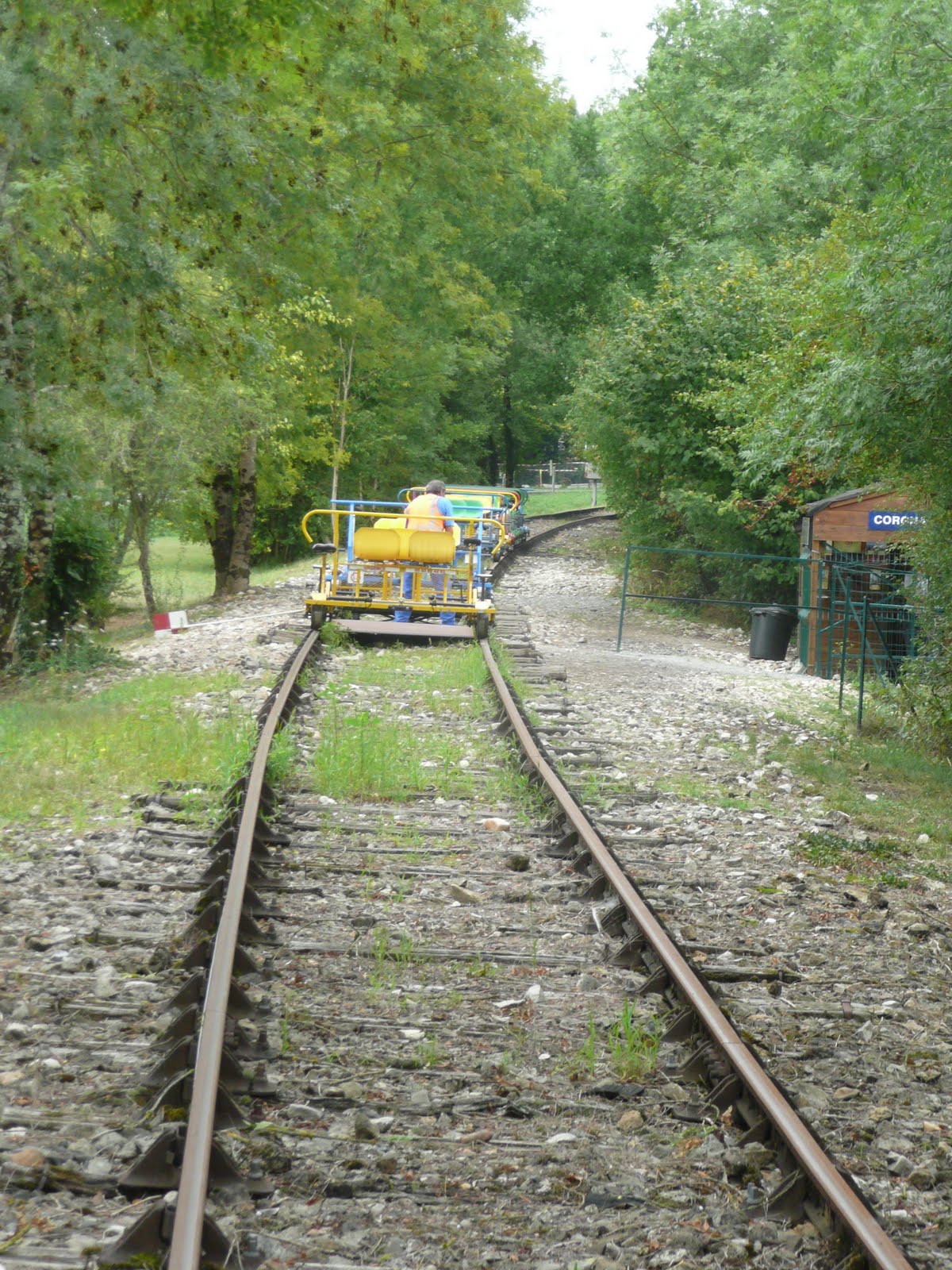
Ever since our first velorail experience in Normandy last autumn I had wanted to have a go at this activity. Our family holiday this year was in the Dordogne area of France and a quick search of the Velorails Federation website pointed to another opportunity at the nearby town of Corgnac-Sur-L’Isle (http://www.veloraildefrance.com/velorail-24.html). I persuaded the tribe to come again to explore a different line! A rather different type of outing this time!
Trains Heading Out
As a quick reminder for those that haven’t read about our previous experience, France still has many miles of disused railway lines that are still intact. Apparently they are retained for strategic reasons in case the military need to use them and removal only happens once a solid case is put forward. This has led to the development of velorail (railway cycling) as a popular way of exploring some of these otherwise redundant and unused lines. There are approximately 40 velorail operations across the country.
Corgnac Sur L'Isle Station
The Perigord Vert operation is a rather different kind of experience to the one in Normandy. Firstly we had to turn up at a specified time, which we had to book in advance. We chose the 10am slot, on the basis that it might be a bit hot later in the day. We needn’t have worried as the weather was decidedly overcast, which was disappointing from the point of view of taking pictures. For pedalling though it was a bit of a godsend.
Rolling Stock
The ‘station’ at Corgnac Sur L’Isle where the rail cycles are collected is actually a little way out of the small town and not at the railway station. There is a small booking office and a line-up of rail cycles which is the only clue that the operation exists. According to the website there is a choice of routes from here, one way to Thiviers and the other to St Germain. The reality, certainly on the day we visited, was that the route to St Germain doesn’t actually seem to be available for the moment since all the timetabled slots were for Thiviers only.
River Crossing
The line forms part of a longer route that once ran from Brive to Angouleme across a very rural part of what is now known as the Perigord Vert. A railway line still crosses this part of the country, although from Limoges to Perigueux. It does at least pass through Thiviers, although I don’t think there are many stopping trains. The Brive-Angouleme line was opened fully in 1889, although some sections of the line opened rather earlier on a piecemeal basis. It closed for passenger traffic in 1940, presumably due to the war, and it never re-opened.
Heading Uphill
Goods traffic continued for some time afterwards in the shape of tobacco, wood and materials from foundries. The line closed in sections from 1960 and finally closed for good in 1993 and the remains were bought by the Departmental Government of the Dordogne. I understand that other sections have no track remaining, but the trackbed has been converted into cycle path, although the route is a bit fragmented.
Signage
This velorail was a little more expensive than last time (25 Euros) and slightly shorter at 6.5km (13km there and back). There were no rules of the road to worry about before we left. The reason for being timetabled soon became clear when we set off with all the other participants at regular intervals. Thus everyone was initially travelling in the same direction, meaning that no lifting cycles off the railway was necessary. The cycles themselves were very similar to the ones on our previous experience with no gears and so only modest speeds can be achieved.Braking is fairly rudimentary with a metal shoe being applied directly to the wheel! Anyhow, after the initial novelty value of the cycling it felt really good to be cycling along real rails again.
Level Crossing
Shortly after getting going we came upon the former station at Corgnac-Sur-L’Isle. This was still in very good condition and a siding still contained some vintage looking rail inspection vehicles and even an old looking diesel unit that still looks serviceable. The platforms of the station were pretty grassed over and would probably need to be relaid if the line were ever to re-open, even as a tourist line.
Woodland Viaduct
Past the station and we crossed the L’Isle river by way of a cantilever bridge, a rather interesting way to cross a relatively modest sized river. The L’Isle drains away into the mighty Garonne at Bordeaux. A little beyond there and we came to a level crossing. Unlike ‘live’ railways the priorities are different at level crossings. Velorailers give way to road traffic and the owners of this operation were not taking any chances.A barrier had to be opened in order to continue on our way and we actually had to cross carefully on foot for this first crossing was actually a well used road.Indeed, there was a slight build up in velorail traffic as we had to wait for a couple of cars to pass. As with Normandy, the crossing keeper’s cottage had a beautifully laid out garden alongside the rail line.
Eyzerac-Labaurie
Just beyond the first level crossing the reason for the style of operation became clear. From a fairly level section of track, the line began to climb gently and rather more effort was required to move our ‘train’. Another level crossing followed shortly after although this time there was no barrier. We were required to get off and walk again across the level crossing. Probably a sensible requirement, but slightly frustrating nonetheless as it seemed slightly unnecessary.
Final Crossing
From the second level crossing the line began to climb a little more steeply and as we puffed a bit we passed a sign that advised that it would be uphill for the next 4km and offering some encouragement to keep going! The third level crossing soon came and this one was protected by quite a loud bell, which appeared to be activated by a trip sensor between the tracks triggered as we passed by. I suspect that this technology is still employed on rural lines that are still operational in France.
Tunnel
The line became a lot more wooded in nature from here on and views out across the surrounding countryside were only fleeting. The countryside was largely agricultural with plenty of cows in evidence. Most seemed to be laying down – were they trying to tell us something? Of perhaps more interest than the surrounding countryside though was the wobbly nature of the rails. They had obviously suffered from years of not being maintained to a standard that would be suitable for powered rail transport. Even on a rail cycle we leaned and rumbled a bit over the rails. Some of the sleepers looked pretty rotten and I suspect that some replacements will be needed in order to maintain the operation.
Thiviers By-Pass
Towards the top of the slope we reached the station of Eyzerac-Labaurie. Some distance from the villages of the same names, it is now a private residence although the rather elderly chap that lives there seems to be very friendly towards velorailers as he gave us a cheery wave as we passed by. He keeps the old station beautifully, although the platform now resembles a lawn rather than its original appearance. No passengers have got the train from here since 1940 and yet the old place looks like it could reopen for business tomorrow!
Refreshment Point
At the end of the platform we again came across a level crossing, the last time that we did on the way out. Not only was there a barrier crossing but also a rope that we had to lift over the kids in order to move forward. This was clearly a reminder to make sure that all riders crossed the road on foot rather than on the bike. The slope continued beyond the level crossing and we passed through a short tunnel, which caused a little excitement with the small passengers on our ‘train’. A little way past the tunnel and we reached the end of the line. Thiviers station is on a busy operational line and so the velorail operation stops short of the junction at the back of a house with a decent sized garden. This has been turned into a refreshment stop serving coffees, ice creams and other drinks.It was a welcome break after the surprising slog up the line from Corgnac.
Heading Back
Turning all the rail cycles was performed by the staff rather than the riders. All the outward riders had to be accounted for before there was any chance of us heading back and so the layover was approximately 20 minutes. We sat and had a coffee, which was a very civilised way of passing the time.
Downhill all the way
We re-boarded in turn and waited for our slot. The system resembled a ‘real’ railway in that the start was signal controlled. I am guessing that the departing cyclists would trip something on the rail on the way down in order to reset the colour light signal in front of us. Once the green light came on it was go-go-go!
Kinky Track
As soon as we set off it immediately felt like a different ride! Of course we were now losing all the altitude that we had gained and once through the tunnel and across the first level crossing we gave it as much speed as we could. Our speed was probably fairly modest as the gearing of the rail cycle wasn’t set up to allow for great speed. Yet, it did feel like we were licking along at the speed of an express train – very exhilarating! Even the bumpy track didn’t feel too bad, although going round the corners Pendolino style was a little scary! Going along at this speed quickly made me realise why this line had operated in this style. Trying to stop one of these rail cycles to allow another coming the other way to get off would be nigh on impossible.
Speeding Along
As we hurtled down the track we were acutely aware that we had to stop at the elevl crossing. Firstly though another unexpected hazard became clear as a shoe came speeding past us, having left the foot of one of the cyclists ahead of us. There was no way the poor lady was going to stop to retrieve it. Countless drinks bottles and other ‘luggage’ could be found on the track, I am guessing from others having had a similar experience!
Stop!
Eventually we drew into the village of Corgnac once again and reached the level part of the track. After the downhill section it was rather hard work trying to pedal very fast again as we had to put some effort into the last couple of kilometres. After passing across the bridge and through Corgnac station once again we were back at the beginning in rather less time than on the outward journey!
Inter City Coming Through
This was another hugely enjoyable velorail experience. My only criticism of these operations is that they seem to have little in the way of information available about the lines themselves – I had to rely on other sources to find out anything about this one and even then there wasn’t a big range of sources to choose from. The railway infrastructure though is largely complete and for this I am very pleased for so much has been lost of our rail heritage in this country. I was less sure that this operation would be a pre-curser to a heritage railway project and slightly mystified by the advertising of a route that didn’t seem to exist, onward from Corgnac to St Germain. It might be my only just able to ask for necessity French that meant I was missing something about the onward route. If you do visit though and you manage to do the section to St Germain I would be very interested to know about this route and how you get to ride on it…
Final Stop