Showing posts with label Mayor of London Discovery Trails. Show all posts

Monday, 1 October 2012

Mayor of London Discovery Trails - Blue Route

Tower Bridge
After completing the Yellow Route of the Mascot Trails we still had enough time left to complete the last route as yet unexplored – the Blue Route.  This turned out to be possibly the longest route of all (although the official length was slightly less than the Red Route – didn’t seem like it!).  We headed down to London Bridge Station so that we could find the start of the route near to Tower Bridge.  This walk promised much as we would see the famous sights of Tower Bridge, HMS Belfast, the Modern Tate, Millennium Bridge, St Paul’s Cathedral, the Monument and The Tower of London.

City Hall
The river looked at its very best as we found our way onto the riverside walk.  Because the start point wasn’t near a Tube Station we had to along to the start of the route just outside City Hall.  This is a curious looking building as it looks like a slinky toy that has been knocked over slightly.  The first mascot was just across the way from the building and was ‘Skyline Mandeville’; a celebration of the new-found confidence in the city that is causing the building of lots of new and distinctive looking high rise buildings.  This part of the riverfront was very busy, with many people drawn to the large screen that had been provided for the Paralympics.  Tower Bridge looked resplendent with the Paralympic Symbol, which had replaced the Olympic Rings the week before.

Skyline Wenlock
We headed upstream along the river front, soon coming to the next mascot which was Maritime Wenlock, positioned outside London Bridge City, where much of London’s cargo trade was once housed.  As with just about all the dockside stuff this has now been gentrified and turned into another use – in this case a very attractive looking and well appointed shopping arcade.  The star of this part of the riverbank is undoubtedly HMS Belfast though.  This veritable old warship looks better than ever, thanks to recent renovations.  I made a mental note to take a visit one day as this World War II veteran has a fascinating history.

Tower of London

At London Bridge our route departed from the riverbank for a short distance and we passed by one of the least known cathedrals in the UK let alone London, the rather attractive one at Southwark.  The contrast between this old church and the enormity of the recently opened Shard Building behind was quite amazing.  Surprisingly, although the church is very old (some say parts of it are 1000 years old), it did not become a Cathedral until 1905 when the diocese of Southwark was created.  We didn’t have time to go inside sadly, although I understand it has starred in a number of films over the years due to its interior beauty.  Outside the cathedral was the appropriately decorated Cathedral Wenlock.

HMS Belfast

We pushed on past a museum devoted to Prison Life (there seems to be a lot of interest in these dark subjects in London) and then a mock up of The Golden Hind, the flagship of Captain Drake, the first ship’s captain to successfully circumnavigate the globe (although Magellan’s crew had previously done it, the captain himself was killed on the way round).  By the ship was the next mascot, Pirate Wenlock.  Since many people think of Sir Francis Drake as little more than a pirate, this again was quite an appropriate choice.
Southwark Cathedral and The Shard

After passing the Golden Hind, the crowds dissipated for awhile as we headed under the railway bridge carrying tracks across to Cannon Street Station, the nearest to the Bank of England and something of a commuters hub that is a lot less busy at the weekend.  The old station is nothing like as grand as it used to be, with its former glass overall roof being replaced by more remunerative offices and shops on the upper stories.  Only the two towers that flanked the glass roof remain, standing out like beacons amidst rather more uninspiring architecture.  As this was a Friday the bridge was busy with trains, although the station itself is closed on most Sundays.  Having been under many threats of closure since the War it is perhaps gratifying that the station is here at all still.
Pirate Wenlock

Just the other side of the bridge and we passed by Rainbow Mandeville, a duplicate design to the Rainbow Wenlock in Regent’s Park, showing how the four nations of the UK were being brought together to help deliver the Games.  As we headed westward the crowds started again and we soon realised that we were approaching the Globe Theatre, the replica of the original Shakespeare Theatre that was burned down after a stage accident and then pulled down by the Puritans in 1644 following its rebuilding.  The new Globe Theatre is a short distance from the original as that site is now occupied by other listed buildings!
Cannon Street Station

Outside the Globe was a generic Mandeville, still attracting plenty of attention due to its location.  I did think it was a shame that it couldn’t have been one celebrating Shakespeare’s contribution to the capital.  Just along the way though was Arty Wenlock, at the base of the Millennium Bridge and outside the Tate Modern.  By now the crowds were huge and so we lingered only long enough to get a few pictures of the mascots before heading off across the bridge.  It was our first time on the Millennium Bridge, some 12 years after it first opened and 10 years after the changes that prevented the ‘wobble’ that people experienced as they crossed.  I am happy to report that there is no such wobble now, especially important considering the number of people using it that day.
The Globe

The view across to St Paul’s Cathedral is magnificent and despite the crowds we could see that the design to incorporate this view was really well done.  The views up and down the river were also very good, although we didn’t really have the opportunity to stop and admire due to the weight of foot traffic.
Arty Wenlock

The walk on the north side of the river had a rather different character as it led through the business districts of the City of London.  We passed by St Paul’s Mandeville and Mansion House before taking a loop around the eastern end of St Paul’s Cathedral.  Its dome looked absolutely magnificent in the late summer sunshine.

Millennium Bridge

Below the dome was Telephone Box Wenlock, celebrating the famous old design that has made these 20th century additions to the street landscape so popular.  As we paused to look another old symbol of London, the iconic and original Routemaster bus, now phased out except on a couple of heritage route, including this one.
St Paul's Cathedral

Across the road from St Paul’s in a little hidden corner of seating was Sonnet Wenlock.  Surely this one would have been better placed at The Globe?  By now we were starting to get mascot fatigue and were anxious to finish the trail.  Luckily the next three; City Gent, Giant and Sir were all close to each other – the last being in the courtyard of London’s Guildhall.  This fine old building was one of the few to have been spared during the Great Fire of London and dates from 1441.  It is still used as the ceremonial building for the City of London (not Greater London, of which the City) is only a small part.  Sir Wenlock was also unique in that it was the only one of the mascots not to show the one-eye trademark.  ‘Sir’ had a helmet to complement his suit of armour!

Passing Routemaster
Having ticked off a few in quick succession it was a fair distance to the next mascot stationed at the foot of the Monument.  On the way we passed the ‘Old Lady of Threadneedle Street’ as the Bank of England is sometimes called.  We also passed by some of the most impressive looking Victorian buildings of commerce that surround the Bank.  The feeling of establishment was all around us, but a different atmosphere to that we experienced around Westminster.

Telephone Box Wenlock
The Monument is one of my favourite places in London.  Sadly the old stone column, which was erected in memory of the Great Fire of London in 1666, is now completely surrounded by tall buildings and seems a little lost.  It must have been hugely impressive when it was first erected and even now the view from the top is quite startling, once you have your breath back from climbing the 311 steps that is!  The mascot equally celebrates the Great Fire in which most of London was destroyed but at remarkably small human cost (only six deaths were recorded).  The London that emerged from the ashes was brighter and better, with a street plan that has largely survived to the present day.

London Guildhall
Having found the Monument Wenlock it was a fair trek to the last two, Ravens and Beefeater.  These are probably the most famous residents of the Tower of London; both guarding the old fortress and prison in their own ways.  The mascots drew a lot of attention unsurprisingly, as they were stationed along the perimeter wall of one of the most famous tourist attractions in London.  Strangely though the mascots were reversed from the suggested locations on the map – not sure why.  It did mean though that ‘Beefeater’, which was probably the more attractive of the two had Tower Bridge as its backdrop.
Sir Wenlock

So ended our tours of all the six mascot trails, or ‘Discovery Strolls’ as they were officially called.  We spotted 82 mascots altogether and walked 23km officially across the six trails.  It was a remarkable way of seeing London and while I didn’t think much of the mascots initially I have to say that done up in their various guises I did warm to them.  Possibly it was the brightly coloured artwork that I liked far more than the mascots themselves.  

The Monument
I understand that since the close of the Paralympics’ Games all the mascots have been taken away, but the routes are still worth following, for they will give you a great sense of our Capital City.  The mascots themselves have been auctioned off to raise money for charity, many of them raising five figure sums.  We have to make do with pictures of each one as a reminder of our remarkable summer.  Following the end of this walk we headed off to the Olympic Stadium for a well-deserved sit down and watched the remarkable Paralympics’ athletes put in some great work during an entertaining evening of sport.

Beefeater Mandeville

Thursday, 27 September 2012

Mayor of London Discovery Trails - Yellow Route


Pearly Mandeville

For me this was the most surprising of all the mascot trails as it was the part of London I knew least about.  The Yellow Trail started at Liverpool Street Station and toured the East End around Spitalfields and Brick Lane, coming back via Leadenhall Market and Lloyds of London.  It was the most mascot heavy route we had visited thus far, with 16 mascots to find in the 3.2km length of the route.

Lunch at Spitalfields Market

It took awhile to find the right way out of Liverpool Street Station.  This is a station I hadn’t been to for years and my last recollection was of a not very nice and rather dingy place in the 1980s.  It was anything but now, with a light and airy concourse and the old place looked like it had really been spruced up for the Olympics and Paralympic Games.  We were in Londonthis time for an evening trip to the Paralympics and the mascot trails were very much the hors d’oevres of the day.

Christ Church, Spitalfields
Once we had found our way out of the station we headed out along Bishopsgate.  It was lunchtime already and the suits from all the surrounding offices were starting to come out for their Friday lunch.  We decided to have some lunch before getting going too much and so when we had found the first of the mascots (Pearly Mandeville), our next priority was to find somewhere to sit down.  We dropped into Giraffe, a place we had seen before but not tried.  It was pretty good, with super quick service and a nice ambience.  The food was a strange mixture of stuff but they did us all proud!

Spice Wenlock
Spitalfields Market was a revelation.  I am sure this isn’t a well-kept secret but we loved taking a look around the market stalls and some of the stuff on offer was really interesting, even for a hardened non-shopper like me!  Around the market were three more mascots in quick succession; Victorian (a very colourful one that showed off some stylised architecture from that era), Spitalfields Market (done up to show some of the merchandise on offer) and finally a generic Wenlock (yawn).

Welcome to Brick Lane
After browsing some of the stalls and surrounding shops we headed on our way through the back streets to Brick Lane, the thoroughfare that has been immortalised in a book of the same name.  This is an area that was colonised by people from the sub-continent of Asia and we passed by Spicy Wenlock at one end of the street and then Sari Wenlock, two representations depicting the culture of this corner of London.

Dickens Wenlock
In fact as we wandered along the street we had slightly regretted the fact that we had already eaten, for the air was filled with some amazing smells of spice and chargrilling meat.  Some of the restaurants had a vast array of colourful looking sweets and nougats in the windows; all exquisitely and temptingly laid out.  It was all a bit different from the upmarket cake shops we had seen around Covent Garden and Picadilly on earlier routes, but equally mouth watering!

Punk Mandeville
A little further on from Sari Wenlock the advertised mascot had been changed.  It was billed as Graffiti Mandeville, but what we actually saw was Park Wenlock.  Apparently the original one had been vandalised, which was a great shame as the odd picture of it suggests that the original was far more interesting than the late replacement.

Paley Upon Pilars
We turned the corner from Brick Lane into Whitechapel High Street and it was like we were leaving one world and entering an entirely different one!  Gone were the tightly packed streets full of shops to be replaced by a huge main road with lorries, buses and taxis thundering up and down.  Apologetically Aldgate East Station had an entrance at this point too.

Cockney Wenlock
At the corner was the next Wenlock, the rather classical looking Dickens Wenlock, showing scenes from the Old Curiosity Shop, one of the famous novels from this most famous of Victorian novelists.  This mascot my vote as the classiest of all those we saw on all of the trails.

Fenchurch Street Station
Somehow on this trail we had managed to leave the confines of the City of London.  As we made our way to the next mascot (no.9 – have you been counting?), we passed the boundary post which welcomed our re-entry into the famous old city.  I don’t know if it was my imagination but the atmosphere definitely changed from a more working class feel to one of hard nosed commerce.  Certainly the buildings changed to very well appointed and classic places that presumably had once been associated with the nearby docks.  Many of course were now banks and other financial institutions rather than the headquarters of shipping companies.

Londinium Wenlock
We came to Punk Mandeville, a nod to the music movement that had its most famous exponents of the Sex Pistols from this area.  I wonder what Sid Vicious would make of a funny little mascot celebrating what he did.  Interestingly the mascot was a Mandeville rather than a Wenlock as billed – not sure what happened there?  I couldn’t help think that it was a little bizarre.  Along from Punk was Cockney, which tried to capture some of the attributes of this most famous group of Londoners.  Being a true Cockney requires a person to have been born within the sound of Bow Bells, and this was represented within the artwork.

Leadenhall Market
At Aldgate was also a very odd sight in the shape of an antique looking timber frame of a house on stilts.  Apparently this is an art installation called Paleys Upon Pilars and is supposed to be a memorial to the cottage that stood on the top of the Aldgate in which the famous poet Geoffrey Chaucer lived.  Its height is supposed to signify the Dream Poems that he wrote while living here.  It was put here as one of the exhibits in the London Festival of Architecture and the good news is that it is due to be in place until the end of 2012 and not just its original three month stint.

Leadenhall Market Wenlock
From here we wandered down Fenchurch Streetand it was clear from the hustle and bustle on this Friday lunchtime that business was winding down for the week.  The buildings had certainly become bigger and the people in suits more numerous, suggesting that we were really heading into the heart of the financial district.  Peeping out from one of the side streets was Fenchurch Street Station, surely the most incognito of all the London Railway Termini and the only one that does not manage to get its own Tube Station.

Almost Unnoticed

 On the left hand side of our route was the enormous building officially called 30 St Mary Axe, but known to the rest of the world as the Gherkin Building.  The design of this place is remarkable and for a modern building I think it will get the same kind of attention in 100 years time as many Victorian buildings do now.  Against the blue skies and the puffy clouds it looked particularly good.

The Gherkin

Amidst all the hustle and bustle of this business district the Mayor’s Office had managed to find a small courtyard off Fenchurch Streetwhere they had placed the next mascot, Contemplative Mandeville.  It is hard to think of a more appropriate setting for such a theme!

Scary Sculpture

Perhaps the biggest and most welcome surprise was entering Leadenhall Market.  Firstly I had never heard of the market before and secondly it was the most wonderful Victorian architecture I had seen.  There was an amazing buzz about the place as everyone was enjoying their lunch hour, either by sitting and chatting in the open air cafes or browsing the wonderful looking stalls.  The two mascots here were very fitting – the first was Londinium, a mascot dressed as a Roman Soldier to recognise that this was the original part of Londonthat was founded in Roman times.  The second was Leadenhall Market Wenlock, possibly my favourite mascot of all the ones we found on any route.  It was decorated as a facsimile of the market itself and made for a very colourful statue.  I’m sure it sold for a lot of money – most went for around £10,000.  I would have to make do with pictures.

Bishopsgate Wenlock
We turned out of the market and headed around the Lloys of London building to find most appropriately Business Mandeville standing around the back.  Across the road was a pink Mandeville figure, which was supposed to be Splashy Mandeville.  Sadly for us the original had been changed but a new plaque had not been given.  I later found out that this one was called City Cycling Mandeville, although no explanation had been given as to why it was replaced.  Next to the mascot was a sculpture of a different kind – I’m not sure what it was but it looked like a rather sinister Guy Fawkes, its face stripped away to reveal the skull underneath.  We moved on quickly…

St Botolph's Church

After such a cluster of mascots it was surprising how far we had to walk to the last one on the trail – called Bishopsgate.  On the way we finally passed right underneath the Gherkin and also a number of building sites for some equally large glass fronted buildings in various stages of construction.  Walking around this part of London made me realise how much the city was changing now that the old buildings are being replaced by these shiny and gleaming towers.


Liverpool Street Station

Bishopsgate Wenlock didn’t disappoint.  It was outside St Botolph’s Church and showed a representation of one of the original gates to the City of London.  We were now practically outside Liverpool Street Station once again and finished with the Yellow Route.  I have to hand it to the planners of the route – it was possibly the most varied and certainly the most surprising of all the routes.  I hadn’t expected such great sights and atmosphere from this part of Londonbut it was really buzzing.  We enjoyed this one a lot!

Monday, 24 September 2012

Mayor of London Discovery Trails - Red Route

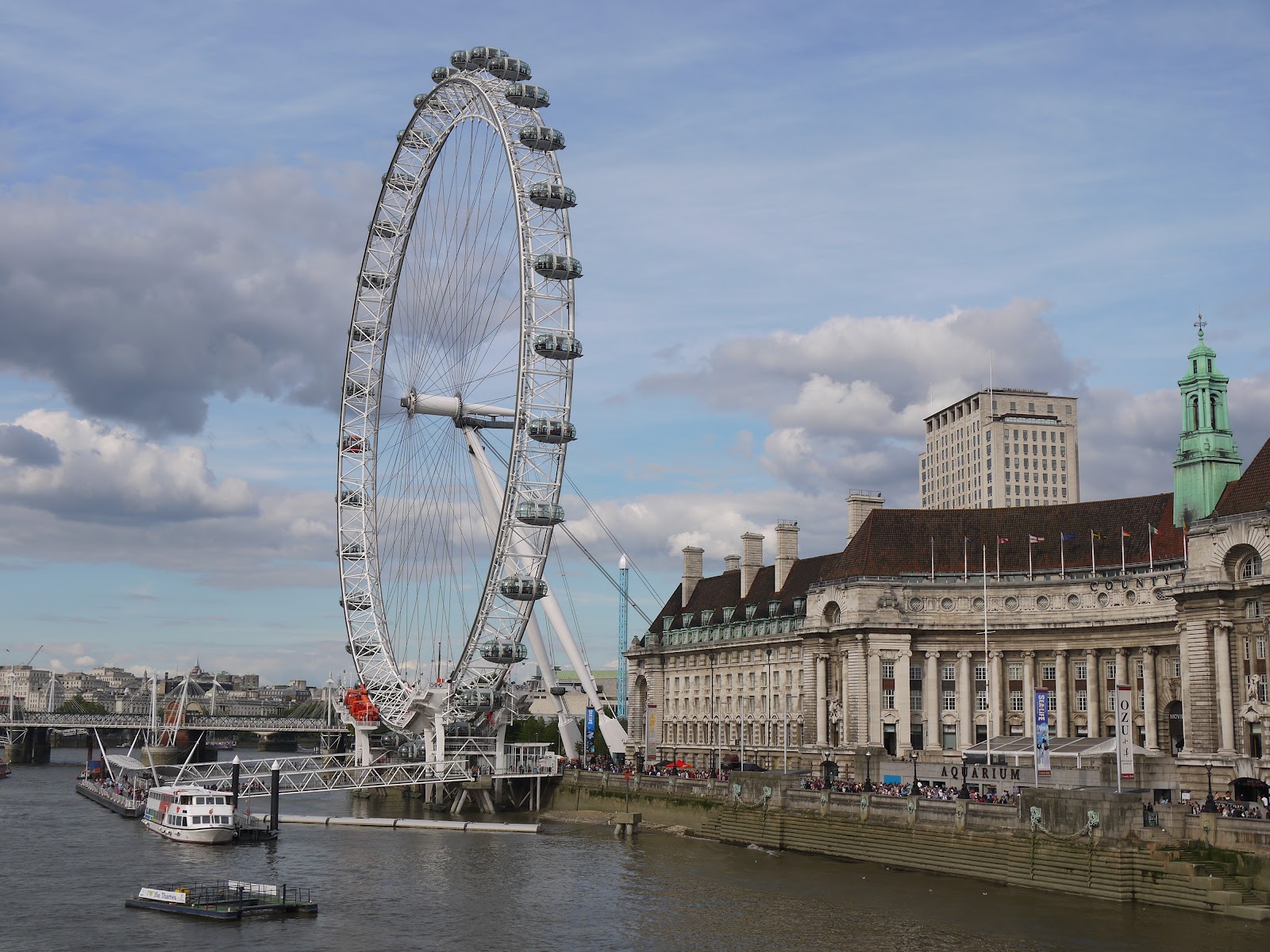
London Eye and County Hall

Our last expedition on our day of mascot hunting was the Red Route, probably the most straightforward to follow as it mostly followed the River Thames on both sides between Westminster and Lambeth Bridges, taking in the famous sights of the Palace of Westminster, The London Eye, Lambeth Palace and the old County Hall along the way.

Boudicca Statue
We emerged from the scrum at Westminster Tube Station and were met with the impressive sight of a statue of Boudicca, the infamous and tragic Queen of the Iceni Tribe, who stood up to the Romans after they betrayed her.  It was good to see such a prominent statue of her and she certainly got a lot of attention from passers-by.  We had to negotiate Westminster Bridge, possibly the busiest stretch of footway we had come across all day, and making Regent Street look quiet!  


Union Jack Mandeville
 Our first mascot was another Union Jack one, directly outside the old County Hall.  County Hall seems to have taken on a new purpose now that it is no longer the fiefdom of Ken Livingstone and the Greater London Council, who used to occupy the buildings.  After abolition of the Council in 1986 County Hall has become a tourist attraction in its own right, housing a Sea Life Centre, a number of food outlets and the ticket office for the London Eye, situated at the far corner from where we were.

Big Ben View

Our route took us in a big loop around County Hall, where we found another plain mascot at the rear, to the far corner where we got to see the London Eye up close and personal.  The queues for riding on the Eye were enormous as usual.  The original intention of the Eye being a temporary structure seems preposterous now, but when first built for the Millennium that was the plan.  It is now supposedly the most visited paid-for attraction in the UK and judging by the crowds I have seen every time I have been I can well believe it.

Big Ben Wenlock

After shuffling our way through the crowds we found the next mascot, not with an Eye theme as you might think given its location, but a nod to the view across to Big Ben.  This statue was preposterously popular and trying to get pictures of it proved very difficult as children were propelled towards it so their parents could grab that all-important picture.  Little did the rest know that we were now half way through spotting them all!

Fish Lamps

We wandered down the front of County Hall and I found some of the architectural detail of the building most interesting, even though it was difficult to see exactly what it was in some cases as some of the pieces were quite a long way away.  We decided to take a rest for a bit as the crowds were getting to us a bit.  A drink and a sit down to recharge our batteries really did the trick and we set off once again after a few minutes break.  Outside the café was the next mascot, Underwater Wenlock, recognising its position near to the Sea Life Centre.  Our route then took us along the River Thames embankment, underneath Westminster Bridge.  Once we had cleared the bridge the crowds dissipated quickly and the onward route was much more pleasurable as a result.

Speaker Wenlock

For my money the walk on the south bank overlooking the Houses of Parliament is probably the best stretch of the River Thames Embankment through London.  The views of the Palace of Westminster and the clock tower containing Big Ben are fantastic and the tree lined walkway is classy.  I was also fascinated by the design of the lights along the river wall - they seemed to depict some kind of sea creature although I couldn't what kind of fish they were supposed to be?  Out on the river there was also much going on, with the Clippers plying their trade, while one of the World War II amphibious vehicles that provide what have become popular tours were trying to keep out of their way!

Thames Craft

The mascots along the riverbank were spaced at regular intervals, the first being Speaker Mandeville.  The Speaker is of course effectively the chairperson of the House of Commons, keeping the sometimes rowdy MPs in check during their Parliamentary debates.  It was interesting to see that this was the role that was celebrated rather than the Prime Minister, but then I guess that is more to do with the more ceremonial dress adopted by the Speaker that sets him or her apart from the crowd.

Lambeth Palace

The next mascot was less obvious, being another Tourist.  The Mandeville mascot though seemed to pay homage to traditional buildings rather than a camera wielding version as at Covent Garden.  The mascots along this part of the trail were exclusive to look at though – no crowds around them as we had witnessed earlier.  Behind the wall on the other side of our path was the large expanse of the St Thomas’ Hospital complex and this was celebrated with the next mascot, a Wenlock dressed up as a doctor.

Palace of Westminster

Just beyond the Doctor was a memorial to the Special Operations Executive.  I had never heard of this before but apparently it was a British organisation set up in World War II to conduct espionage, sabotage and reconnaissance in occupied Europe against the Axis Powers and to aid local resistance movements.  Needless to say it was top secret and full of extremely brave people.  London seems to be full of these memorials to pieces of history that I know nothing about and this is one of the reasons why a walk around the Capital is so fascinating!

A-Z Wenlock
By now I think we were all feeling a bit of mascot fatigue and we were rather displeased to have to cross the very busy Lambeth Palace Road to find the next mascot, Lambeth Palace Mandeville, outside the gate of the famous old Palace.  This is of course the London residence of the Archbishop of Canterbury, the leading cleric of the Church of England.  Apparently at the rear of the Palace are some wonderful gardens although there wasn’t time for us to check them out this time.  We had instead to make do with seeing Garden Wenlock, the tribute to the gardens stationed at the end of Lambeth Bridge.  As Thames bridges go, this seemed to be quite a quiet one and was in stark contrast to the hoards we had to endure on the next bridge downstream earlier on the trail.

Westminster Playground
The remaining mascots on the trail were all in the gardens of the Palace of Westminster.  This is the place where we always see our politicians being interviewed so it was funny to see the place in a different context!  The first one we came to was that iconic tool of every taxi driver, the A-Z map.  I can remember my Dad having one of these as a kid and being bewildered by the number of roads on every page.  It seemed unfathomable to me that so many people could live in London and even now as an adult with experience of hundreds of trips to the Capital, I can only just about find my way round.  I guess even in these days of Satnavs and smartphones the humble A-Z still has its navigational place?

Household Cavalry Wenlock

When we entered the park we passed a rather lame looking playground.  I assume the politicians don't play here otherwise I am sure that the facilities would be far better!  The last mascots on the trail were much to be expected.  We had Victorian, Household Cavalry and Westminster Abbey mascots in various parts of the park.  Most of the tourists though were at the Palace end of the park looking at statues of some of the famous people on show.  The Rodin statue of the Burghers of Calais was particularly popular, although personally I liked the Buxton Memorial to the abolition of slavery better.

Buxton Memorial

This was the end of the trail and due to the linear nature of it, realistically we had to close the loop and return once again to Westminster station.  The Red Route seemed to celebrate governance of Britain, taking in the seats of Government and the Church en route.  It was a straightforward trail to navigate, which was welcome after the more convoluted trails that we had completed earlier. It had been a long and tiring day but we managed to see 39 mascots in total across the three routes.  A pretty good effort we thought and despite the kids being very tired they were still asking whether there was time to see more?  Not today, but we had planned a last trip to walk the remaining two routes on another day. 

Richard the Lionheart