Showing posts with label Town and City Trails. Show all posts

Tuesday, 29 October 2019

Rouen City Walk

Rouen Cathedral - Summer Light Show
When visiting any new city it is worth seeking out the tourist information centre to see if there is a published walk that will take you all around the major sights or points of interest.  We have been to Rouen a number of times but not for many years so we wanted to pack a lot into our time here.  The tourist information office in Rouen is directly opposite the Gothic cathedral.  The cathedral is surely the centrepiece of this remarkable mediaeval city and has survived Viking invasion and World War II.  The first occasion it was destroyed entirely and rebuilt, while on the second it sustained a lot of damage but you wouldn't know such is the fantastic restoration.  The frontage is full of the most exquisite detail that no camera can properly capture its majesty.  We spent a lot of time admiring the frontage before going inside.  It is as grand inside as it is out and a few interesting features to point out are the tombs of Richard the Lionheart and Rollo, founder of the Duchy of Normandy in 911.  There is also an interesting set of photos detailing the damage sustained by the cathedral in the War and how it was restored.

Grand Clock
Before moving on it is worth looking at the building that the tourist office is in.  This was once the House of the Exchequer and it was from here that Claude Monet painted his series of Cathedral scenes in the 1890s.  We used the route as a guide rather than following it religiously partly because it seems to be two loops from the starting point of the cathedral.  Thus we followed the next part back to front and headed down through the pedestrianised streets towards the Great Clock for which Rouen is so famous.  On the way we detoured one block to take a look at the huge Palais De Justice, a large edifice that no doubt has played an important part in a good many lives in this area even if a lot of people don't wholly know what goes on there.  

Spy
Over the course of the week we stayed in the city we probably passed the Great Clock at least half a dozen times and it looks just as good at night lit up as it does gleaming in the sunlight during the day.  The clock itself is a slightly strange mix of Gothic belfry, Renaissance archway and clockface and an 18th Century fountain.  It seems to sit so well among the surrounding buildings in this busy street.  We continued down through the pavement cafes between all the people gossiping and drinking coffee and wine before crossing the appropriately named Rue Jeanne D'Arc, by far the most person associated with the city.  Jeanne D'Arc is better known as Joan of Arc, a slightly mythical and unlikely heroine who led the French Army to victory over the English during the Hundred Years War.  She was subsequently captured by the Burgundian Army, allied with the English, and handed over as a prisoner.  Rouen was still under English control at that point in the war and it was here that she was brought, declared guilty of witchcraft and burned at the stake.

Historic Quarter
We took a short detour down a beautiful and quiet street full of atmosphere and lined on either side with half timbered buildings which characterise much of the historic quarter of Rouen.  We wandered round to find the Hotel De Bourgtheroulde.  Apparently this old building hosts two sculptures representing the Triumph of Petrarch and the other the episode from the Field of the Cloth of Gold that relates the diplomatic meeting of Henry VIII of England and Francois I of France in 1515.  Sadly the sculptures weren't visible from the street although we did enjoy the intricate detail of the building, which now serves as a luxury hotel.

Flags
The square where Joan of Arc was burned was just around the corner and it was here that we headed next.  The market square is now dominated by a modern church designed in a shape that is meant to evoke the flames that consumed her.  It is a very effective if slightly gruesome design.  Inside are some stained glass windows that were moved here from a nearby church that was largely destroyed during World War II.  Luckily the glass had been removed from the church ahead of hostilities and was thus spared the destruction of the original church.  Around the church were a number of market stalls and cafes but strangely it was quite quiet when we passed by.  I have a feeling that a weekend day would have been a lot busier.

St Joan of Arc Church
Our route now took as through a meandering look at the tight knit streets in the historic quarter.  We were already needing some refreshment though and we soon came upon a rather quirky little cat cafe.  These establishments have become quite popular recently but I have to confess it was the first time I have ever been in one.  The premise is that people call in for their cuppa and share the experience with a number of cats that are only too willing to offer their devotion.  At least that is the theory - in this particular establishment the cats kept us more entertained by staying out of our way high up on the various pieces that had been put there to keep them entertained.  Various perches, walkways and cushions kept them just out of reach as they looked down us disdainfully...

Walking Street
We meandered through the city streets enjoying the ambience of the old half timbered buildings and the eclectic shop windows.  Some of the stuff on offer was quite surprising with junk shops in particular catching our eye.  without really realising it we were slowly looping back towards the cathedral and the other part of the loop that leads around the eastern half of the old quarter..  We passed by the Palais de Justice and the Parliament of Normandy.  It has served as the latter since the 1500s and is beautifully decorated but it is perhaps the very obvious damage from World War II shells that are the most surprising feature of the building not least because of the sheer number of them.
Cat Cafe

The route took us down the north side of the cathedral through perhaps the most delightful of all the streets in the city.  The cafes and bars here are particularly inviting and we took note of a couple that we revisited later in the week.  The prices are a bit steep though so be warned!  Also along this street is the museum devoted to Joan of Arc telling the remarkable story of her short life.  The exhibition recounts her trial through its fascinating twists and turns.  The outcome was never in doubt but getting to the verdict was more problematic than you might expect principally because of the way that Joan conducted herself.  It is a very interesting way of handling her life rather than the more traditional types of exhibition.
St Maclou

Behind the cathedral and across another main road is another incredibly ornate and beautiful church, this time the church of St Maclou, a flamboyant edifice that was started in 1436 but not completed for almost 100 years.  Although the structure has lasted remarkably well history hasn't been completely kind to this church.  It suffered significant damage in World War II, had many of its statues inside removed during the French Revolution and lost much of its internal furniture during World War II.  Nevertheless it is worth pausing to enjoy the intricate stonework of the frontage as we did before moving on.

Bunting
We took a route along a street that had a stream running though it in a culvert.  It was tastefully done and the water was clean and fast moving which seemed to provide a completely different ambience from any old pedestrianised street.  The buildings were still half timbered but we were clearly moving away from the historic quarter now because they were interspersed with the odd more modern one presumably replacements for ones destroyed in the war.  We looped around at the far end so that we could enter the gardens at the rear of L'hotel De Ville.  This beautiful little oasis was worth lingering over with some interesting statues and planting arrangements.  Of particular note is a stone that was placed here in 1911 to celebrate 1000 years since the founding of the Duchy of Normandy by Viking settlers.

Window Shopping
The church next to the gardens is astonishing in scale - this is the Church of St Ouen, built as an abbey church for a long lost Benedictine Order.  It is similar in scale to the nearby cathedral and in any other city would surely be the centrepiece rather than a supporting act in ecclesiastical terms.  The main tower is rather reminiscent of the one you can see at Ely Cathedral in England.  It took a long time to complete, finally being finished in the 15th Century.  The west facade wasn't completed though until the 19th Century and looks rather grubby compared with the cleaner lines of the rest of the church.  Next door at the front is the grand looking Hotel De Ville, with an eyecatching statue of Napoleon astride a horse rearing up.  He certainly looks the all conquering hero in this pose.

Hotel De Ville Gardens
The last part of our walk took a loop around the neighbourhood that starts climbing the hill that forms the side of the Seine valley.  The main reason for following this route is to take visitors to the Natural History Museum and the Museum of Antiquities but we were out of luck because both were closed as was the Rouen Dungeon housed in the only part of Rouen Castle that still exists.  Not on the official walk but worth a mention as it is across the road is the rather fine looking Rouen Rive-Droite Railway station which was completed in 1928 and is a magnificent monument to railway travel.

St Ouen Church
We headed back down the hill from here back to the Cathedral stopping briefly in the garden at the front of the museum.  A lot of care and attention had gone into this particular garden - it is obviously one of the jewels for the city authorities.  The museum at the back looked interesting as well but sadly we managed to find it closed on the day we visited.  Do you spot a theme?  A lot of places are closed in August that's for sure but you also have to pay attention to the days that places are closed - a lot of museums close at least one day per week and it's usually a weekday rather than a weekend one. 

Rouen Rive Droite Station
No matter that so many places were closed - you would be hard pressed to include most of them on this walk.  The Joan of Arc Museum is a must as is a visit to view inside the cathedral but other than that you would probably need several days to do the place justice.  Rouen is certainly a fascinating city that is worth lingering in - this walk will help you see most of the main places worth seeing.  Make sure to allow cafe time too - watching the world go by with a cold beer or a coffee is fascinating too!
Hotel De Ville and Napoleon

Wednesday, 26 June 2019

The Southern Ridges

Dragonfly Pond
For a large metropolitan city Singapore is surprisingly well endowed with hiking opportunities, with perhaps one of the most celebrated being this route along the Southern Ridges, a small range of hills that overlook the dockyards and Sentosa Island.  It is not a continuous ridge but the city authorities have put in some ingenious engineering to overcome the challenges of dealing with the valleys that divide the hills.  The path is officially 10km in length but can easily be extended to include Labrador Park.  I also included Sentosa Island into the route for reasons that I shall explain later.  I began my route at Kent Ridge MRT station, which is the opposite end of the recommended route but walking from west to east always seems to make more sense to me.  It also ensured that I would see some of the highlights at the end of the route rather than at the beginning.

Kent Ridge View
From Kent Ridge station I took a left turn and another left turn to take me on to Science Park Drive, a wide road through what looked to be an area of hi-tech industry.  I was so taken with the shiny buildings that I missed the turn into the nearby park and only realised much further down the road when I came upon some tower blocks in the process of being demolished.  Such was the deliberate nature of the deconstruction that I could only assume that every available piece of concrete and metal were being recycled.  I wandered down into the adjacent park and soon found myself by the dragonfly pond.  I lingered here for a while watching the eponymous insects and enjoying the ambiance of the pond.  All was quiet in the park - I saw only a couple of joggers at this stage.

Friendly Lizard
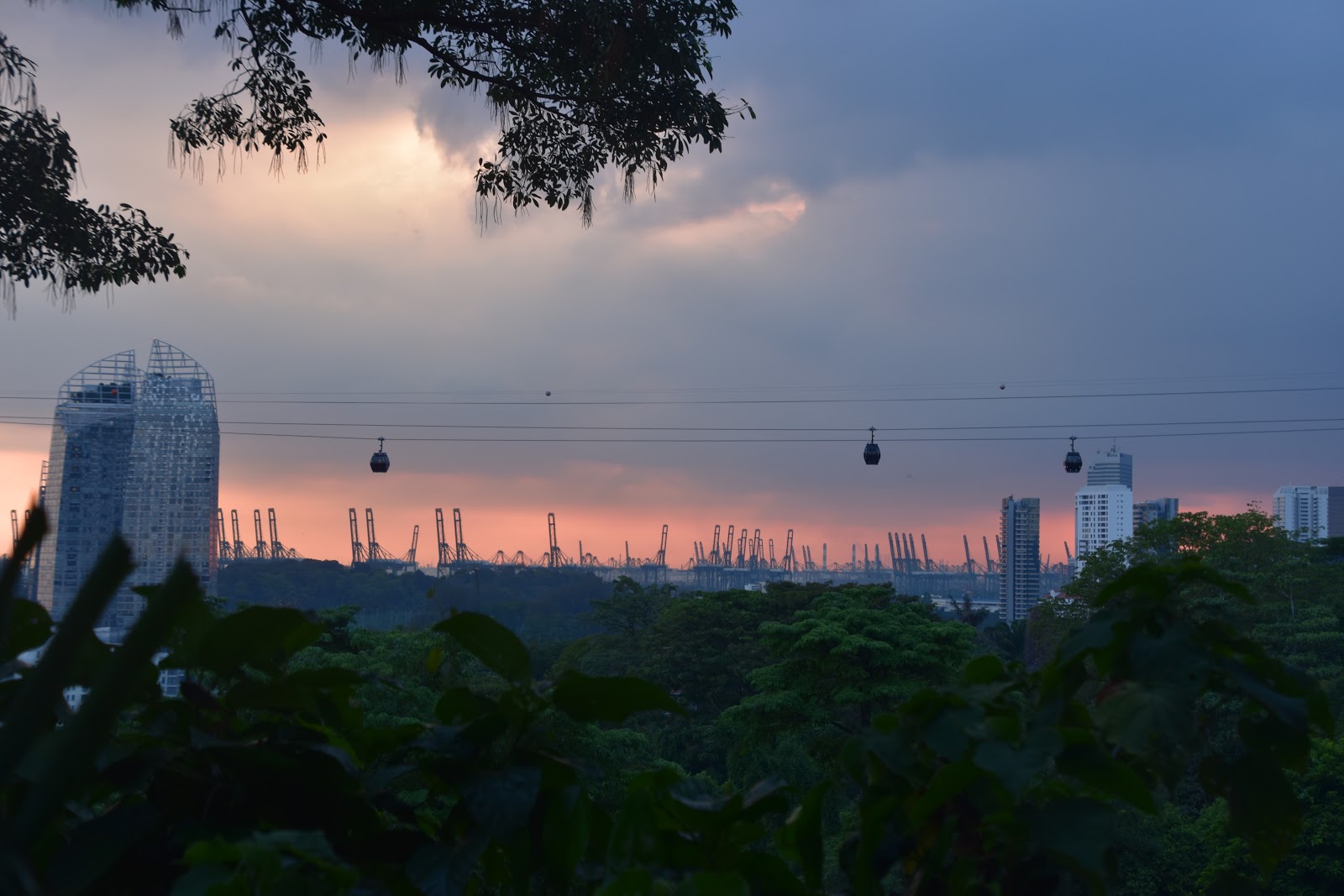
I climbed up the steps and onto Kent Ridge proper where I got my first sight of the port.  When you are in the city the size of the port is not obvious but from up here you soon get a sense of why Singapore has become so fabulously wealthy.  The number of cranes and containers is quite bewildering and the scale of the port is not something I have really seen before.  I imagine that the docking fees and various tariffs is what keeps the country coffers topped up and why the local citizens are able to live such a good standard of life.  While admiring the view I also caught sight of a different kind of local - a small lizard observing me and making sure I wasn't going to be a threat.

Canopy Walk
I walked along the mostly empty car park to a mound further along that had a slightly elevated view of the port and from here I could see a wider aspect as well as a view back over the city for the first time.  This shaded area was far more popular with the locals and a couple of the tab;es were taken by professional people having work meetings - I imagine somewhere like that would be quite productive and popular.  A far cry from World War II when this ridge was held by a garrison hoping to repel the Japanese invaders who came in 1942.  One of the last battles for Singapore was fought here and the result made the British commanders that the game was up and they surrendered soon afterwards in what was one of the biggest defeats the British Army ever had.  Looking at the peaceful leisure surroundings now it is hard to believe that such a place could have such a bloody past.

Hort Park
The onward walk along Kent Ridge was a delight through a kind of arboretum (although it wasn't billed as such).  There were lots of different types of trees and although I couldn't really name any of them I did enjoy their different spreads, foliage and colours.  At the far end the ridge I went to look at Bukit Chandu War Memorial but sadly it was long term closed for renovations.  I met a chap who encouraged me to come again to visit when it's finished as he said it would be well worth it.  I left Kent Ridge here and walked along the tree top canopy walk to get to the next path.  Singapore does these walkways so well - they are all a treat and provide the walker with excellent opportunities to see the foliage and fruits/ flowers that would be impossible from ground level.  One tree I remember in particular was the gloriously named Tiup Tiup tree, a lanky one that is able to recolonise poor soils.  It had small fruits on it that I was able to reach out and touch courtesy of my lofty position.

Hort Park Butterfly
From the walkway it was also possible to see the Former Ford Factory (or at least its rough location for I couldn't really pick it out).  This is another of those iconic buildings in Singapore that is closely associated with the Japanese Occupation for it was in this old car works that the Allied commander, Lieutenant-General Percival surrendered to the Japanese and more than 2 years of occupation took place thereafter.  It is now a very interesting museum recounting this chapter of the war (I visited myself the following day).

Keppel Building
At the bottom of the zig zag canopy trail my eyes were drawn to a bird in the top of the tree above me.  It teased me a little with singing and hopping about just out of range of me being able to see it properly.  I tried and largely failed to get a decent picture of it but eventually gave up - I reckon I am a rubbish naturalist as I don't have enough patience.  It was a beautiful yellow colour though - easy to spot through the foliage. At the bottom of the hill I passed through a gate and into Hort Park.  I smiled as I entered as it hadn't previously occurred to me that this was in fact a horticulutual park where there was clearly quite a lot of research going on.  I soon became aware of hoards of kids too as they were all visiting on a school trip - I mostly gave them a wide berth as I tried to enjoy the peace and quiet of the flower gardens.  It was an exquisite place to wander around - the place was full of butterflies and other insects.  I had hoped that I might have some refreshment at the visitor centre but sadly it was closed on the day of my visit and I had to push on rather more quickly than I had hoped.

Arrival From Singapore
Just outside the garden was the graceful looking Alexandra Arch Bridge which connects this park to the next one at Telok Blanglah.  Apparently it looks particularly special after dark when all lit up.  However, before continuing on to there I decided to take a look at the alternate route that is offered by the parks service and explains why they suggest that the route is completed in the opposite direction.  If approaching from the other direction the suggestion is that the walker either chooses the Labrador Park option OR the Kent Ridge option.  Over-achiever that I am I wanted to do both, especially as I wasn't sure when I might get here again.  I turned right down Alexandra Road after the bridge, passing by a man who was sitting and selling nik-naks (mostly brushes).  This is a sight that I am used to in Thailand but not here - I think it is probably unusual outside the main ethnic areas of Chinatown and Little India.

Dragon's Teeth
The walk down Alexandra Road wasn't that pleasant as it is a very busy road.  To be fair though the city authorities had provided a decent walkway and segregated cycle track.  I was feeling quite hot and bothered as I walked down towards Labrador Park and was very pleased when I saw a shopping centre on the way.  I dived in and had some lunch and enjoyed some air conditioning for a while before continuing onward.  I was pleased to see that there was a system of footbridges linking the shopping centre with the nearby MRT station for that was where I needed to go next.  Behind Labrador Park station is the Berlayer Creek boardwalk.  This was a rather different kind of experience for it passes through a mangrove creek where it is possible to observed wildlife.  To be fair I didn't see much other than the odd monitor lizard, squirrel and crow but that was probably due to the fact that I was now in the middle of the day and most creatures are too smart to be out then.  The mangroves did afford plenty of shade and this seemed to be a popular place for running for I passed many joggers along the way.


Harbour From Labrador Park
Eventually I came to the sea and the channel in front of me was quite popular with several hydrofoils making their way to and from Indonesia judging by the insignia they had on their paintwork.  Although there were of course plenty of people sitting in the park enjoying the warm weather rather bizarrely there were plenty of chickens wandering about too.  I turned right (although the left hand turn along more boardwalks looked equally if not more tempting) and headed towards Dragon's Teeth Gate where I came to the mouth of this particular part of the harbour.  On the opposite shore was the holiday island of Sentosa where I would eventually be headed.  The Dragon's Teeth Gate is an interesting feature as it just looks like a pile of random rocks.  The one that is there now is merely a replica - the original was destroyed by the British when widening the harbour  in 1848.  Just beyond it is an old light beacon and from there I surveyed the biggest number of ships I have ever seen in one place - literally dozens moored offshore awaiting their next assignment.

Former Battery
This was a different if no less interesting perspective of the harbour.  Across the way I could see the towering cranes and the hundreds of containers being swapped between ships and shore transport.  How on earth must it have looked before containers were invented or widely used?  The armies of people employed at these docks must have been unimaginable.  Now the only signs of people interesting with the water were a couple of fishermen fishing in spite of the signs forbidding it.  I looped around this very attractive waterfront park and then headed through the gatewa to the old hill where the wartime batteries can still be found.  This hill was one of the best defended in Sigapore - the only problem was that the guns were pointing out to sea and the enemy came from land via the Malayan jungles back in World War II.  This meant that the defenders were hopelessly ill-equipped to deal with what was a very fierce army.  Although the remains of the batteries are still well preserved any chance of them being used to defend the port would require a serious amount of vegetation and tree removing first as they are all seemingly just enclaves in the forest.  In one of the batteries there was a mock up showing how life must have been for the soldiers manning the guns.  At the top of the hill was supposed to be a viewpoint across the harbour but alas it was mostly blocked by trees.

Alexandra Bridge
At the top of the hill I rejoined the road and looped back around to Labrador Park MRT station and thence back to the shopping mall for a little relief from the hot sunshine.  I retraced my steps back up to Alexandra Bridge and turned right when I got there.  This led to the Forest Walk, another of those seemingly impossible canopy trails that led up to the top of the next ridge.  This one was supposed to be 1500 metres long but it seemed a lot longer.  It was surprisingly quiet - only the odd walker using it.  I heard a lot of bird life as I walked it but in all honesty I don't remember seeing much of it, except for one of those yellow birds which I got a better look at this time.  I learned that it was a black-naped oriole, one of the most common birds that live in parks in Singapore.

Henderson Waves View
The canopy walk seemed to take a while to reach the top of the ridge, not that I was in any hurry for it was the most delightful exploration of the forest.  Singapore really has mastered the art of keeping nature close to city life - I cannot think of too many other cities that have done this quite so well.  It is possible in places to imagine that you are deeper in the jungle than you actually are - with the vibrant city in some cases only a few hundred metres away.  At the top of the hill I came to Telok Blangah Hill Park and initially I walked along a quiet road to a car park not too much further on.  As I did so I became away of a lot of monkey movement in the adjacent part of the forest.  I was relieved when it died down - I didn't much like the idea of being 'mugged' by these creatures who seem to be conditioned to steal food, sunglasses, cameras and any number of loose items.

Henderson Waves
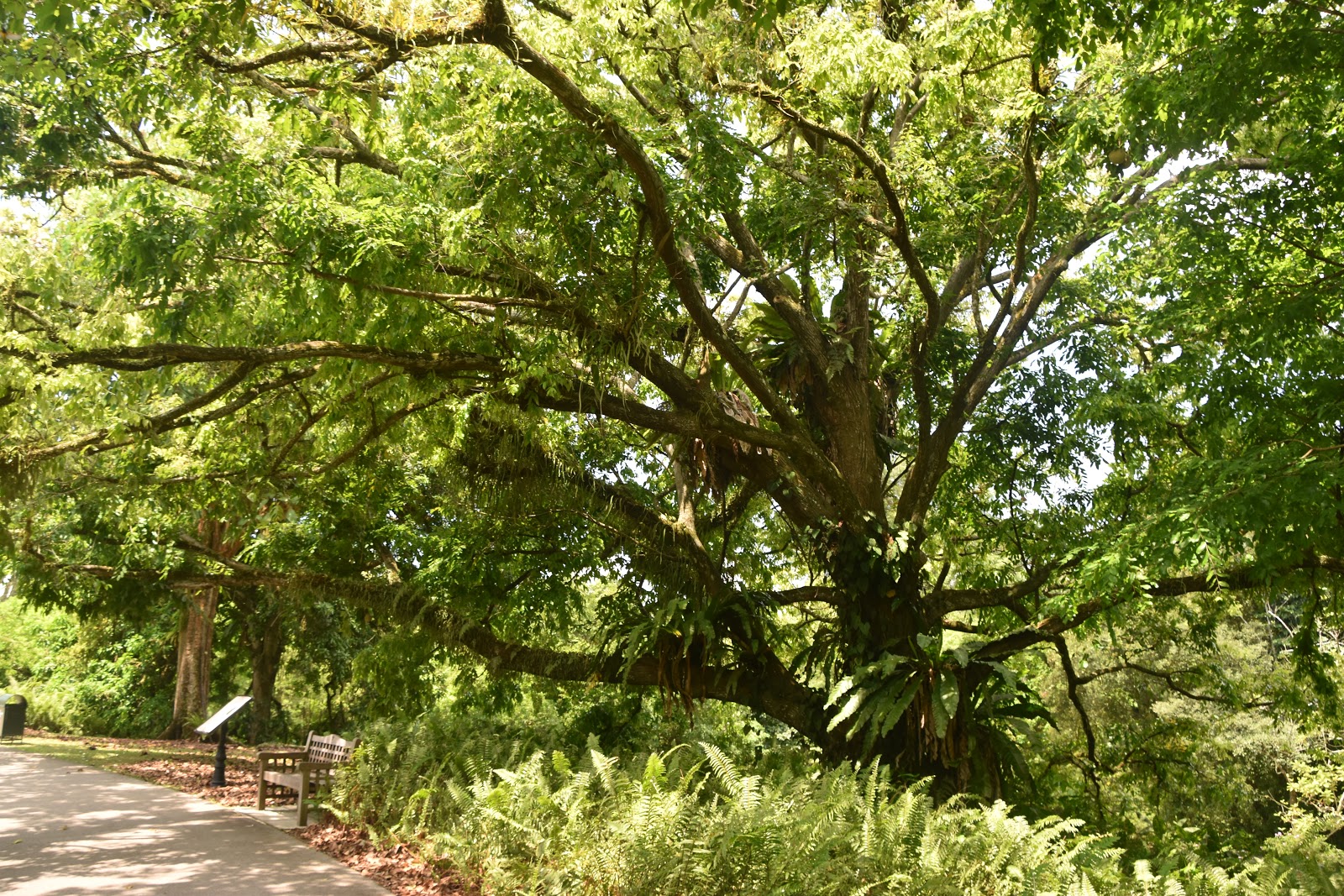
At the car park my onward path was marked by the most amazing tree - it wasn't especially tall but had the most amazing wide spread.  Just before it I passed the most famous house on the hill - the Alkaff Mansion.  This old place is famous as a wedding venue these days and although normally photogenic there was a sign outside asking people not to take pictures as it wasn't at its best during renovations.  I imagine they didn't want any illusions shattered!  From the big tree I had to climb again in order to reach Henderson Waves, an astonishing $25million bridge across to Mount Faber Park.  It is audaciously designed with seven undulating curved steel ribs and built of a locally sourced timber that can deal with everything a tropical climate can throw at it.  The bridge is almost impossible to photograph properly while you are crossing it - you just have to appreciate the engineering as you go.

Cable Car
At the far side of Henderson Waves I was now at Mount Faber Park and the views across to Sentosa Island seemed to make it more appealing.  I determined that if the cable car wasn't too expensive I would try it out.  However when I got to the Mount Faber station I was quoted a price that I thought a bit steep.  I walked away thinking that I wouldn't do it but then changed my mind, went back and was rather pleased when I was offered a discount.  That definitely sweetened the pill and I was soon travelling across in a cabin all on my own - the view across the city was awesome and well worth the price of the ticket.  The first stop on the cable car is a shopping centre and rather bizarrely the station is on the top floor.  The route then continues across the harbour to the island where it drops you right in the heart of all the holiday entertainment.  Sentosa is where Singapore likes to party and there are theme parks, resorts, beaches, all manner of thrillseeker sports and everything you might want from a holiday.

Sentosa View
I took the other cable car that took me to the far end of the island.  I wanted to see a different Sentosa - the old fort that was built to defend it during World War II.  It was a fascinating visit, which I just about managed to squeeze in before the old place closed for the day.  Inside the fort you can see the living quarters, gun batteries, medical centre and various other reconstructed areas and including sound effects that helped you imagine what it must have been like for the defenders.  It is a part of Sentosa that most probably don't come to and I pretty much had it to myself.  I did find it very moving there though - certainly a different experience than the World War II places I'm used to back in Europe.  Once I'd looked around I sensed that it was going to get dark soon and so I went straight back to the cable car and did the two stage journey all the way back to Mount Faber.  I probably could have got off at Harbourfront but I decided to complete the whole journey and was back at Mount Faber in the now fading light (it gets dark very quickly in the tropics)

Mock Up Fort at Sentosa Island
In fact by the time I did get back and walk down the steps to Harbourfront station it was already growing dusk.  I even managed to miss the sunset!  Nevertheless I was pleased that I hadn't come up this way - it would have been quite a stiff climb at the beginning and my route was definitely gentler.  Harbourfront was a more convenient getaway point too - closer to the city centre.

Returning From Sentosa Island
I loved this walk - so much history, architecture, wildlife, forest and views all rolled into one.  Although it seemed a modest length I worked out that after all the additional stretches that I did it was actually 18km in length!  I probably drank my body weight in water during the day; something to factor in when trying to do any walks in the tropics even when surrounded by a big city.

Final View From Mount Faber

Sunday, 2 June 2019

Singapore Botanic Gardens

On Hands
The Botanic Gardens in Singapore are rightly celebrated as one of the premier attractions of this city state and it was top of my list of places to visit on my recent trip.  What I was completely unprepared for is the scale of the place - I imagined that I would be visiting for a couple of hours to do it justice just as I had with its counterpart in Kuala Lumpur.  However, it wasn't long after getting off at the dedicated MRT (tube) stop that I realised that it would take a lot longer to see everything within the gardens.  It is probably twice the size of the Kuala Lumpur gardens and has a lot more to it, with areas dedicated to orchids, wetland plants, trees and even agricultural crops.

Water Gardens
The gardens were established in 1859 when English garden design was being exported to a number of the colonies in the British Empire.  The reason that the gardens started was mostly for agricultural reasons - one of its greatest success stories was to grow rubber after transplanting it from South America.  It did so well that within a few years Malaya was the largest producer in the world. It's transition from colonial garden to one of the foremost botanic gardens in the world was recognised with UNESCO World Heritage status in 2014.

Morning Exercises
Bukit Tanah gate is right outside the exit of the MRT station - no chance of getting lost!I started my journey at this point turning right just inside the gate and heading up into the Trellis Garden.  It was here that my eyes were drawn to some interesting sculptures - they were a couple of entries from a Polish art trail that had come to town.  They fitted their surroundings so well it was hard to believe that they weren't put here a lot longer ago than the previous autumn.  They were going to be short-lived too as they are due to be removed almost immediately having served their time.  My favourite one was called 'On Hands' an acrobatic figure clinging on to a tightrope.  I wandered around this small area of the garden for a while enjoying the flowering bougainvillea and trying to avoid a nursery school outing.  This was not because the children weren't delightful but because they formed a large snake as they held hands through the park.  I certainly didn't want to get in their way!

Meranti Tree
At the far end of the trellis garden I crossed a large open space and entered the herb and spices garden.  This was immediately more intimate than had gone before with the foliage from the plants alongside partially covering the path and a little further on was a small glade with a pool at the heart of it.  I walked through on a concrete boardwalk and enjoyed the ambience of a garden that I could only have seen from the artificiality of a greenhouse back in Europe.  Here the butterflies and tropical fish were right at home and not apparently in captivity.
Ginger Gardens Pond

It was a very hot day and it wasn't long before I needed to have a sit down.  I did so at what was once part of the garden that crop experiments were conducted at.  It has now transformed into a lovely green space that was a relaxing place for a seat.  I wasn't alone - a man had also chosen this spot for a nap.  I kept my distance as he looked out for the count.  Just below my position was some form of visitor centre with a coffee shop which looked very inviting.  I decided though that I wasn't quite ready for a coffee or indeed lunch and moved on wandering past some more mini-waterfalls.  I realised that just as I had done with the botanic gardens in Kuala Lumpur a few weeks earlier that water plays a big part in the landscape of a garden in these parts. I guess with so much to manage during rainy seasons that it is vital to channel the water somewhere and have plenty of capacity to deal with it.
Parasol Dragonfly

As I wandered away from the visitor centre I came upon a small group of older women doing their morning exercises. This is a sight that never fails to mesmerise and fascinate me - the slow movement of these Asian exercises (I think Tai Chi in this case) always looks so controlled and deliberate.  I didn't get long to watch in this case though - they were just about at the end of their session and they dispersed within a coupe of minutes.  I took a small path away from the main tarmac roads that led up into the rainforest part of the garden.  As its name suggests it is a small tract of rainforest of approximately 6 hectares in size that actually predates the garden.  Once up through the steps it was hard to believe that I was in the heart of a major world city.  Within this area are some remarkable trees, including a species of fig that relies on a specific species of wasp to pollinate it.  The was in turn is  wholly reliant on the fig tree for its survival - rather an amazing relationship.  Another was the enormous Meranti, a gigantic tree that  throws roots down from high up on its trunk.  There are approximately 50 of these trees in Singapore but despite wide scale searches no seedling or sapling has been found anywhere in Singapore and it could be that once the existing ones die it will become locally extinct.  This particular one is the only one that is publicly accessible anywhere in the city.

Orchid Garden
I could have spent a lot longer in the rain forest but I was conscious that there was an awful lot more to see and I went from here to the orchid garden, the only part of the site that you have to pay to access.  I cannot say that I am a particularly big fan of orchids but I think that is borne of the fact that I have rarely seen them growing in their natural climate zone.  This part of the garden was truly stunning and worth the fairly modest admission fee to access.  The gardens were beautifully kept and included imaginative planting schemes and sculptures to heighten interest throughout.  I eventually made my way towards the top of the slope that the garden is arranged on.  At the top is a rather palatial looking house,  once occupied by  the director of the gardens called Burkill Hall.  Nowadays it hosts a display of many of the hybrids that have been bred here.  There is a tradition of presenting these to visiting dignitaries and VIPs.  Some of these are the people you would expect including Queen Elizabeth II, but there were also ones for such people as the President of Bangladesh and the King of Lesotho.

Burkill Hall
I stayed in the orchid garden for about an hour and much of the time I spent there was under large threatening looking clouds.  The sun came out completely when I left and by now the day was getting really hot, necessitating regular stops for refreshment.  I wandered through the ginger garden next door to the orchid garden, where I saw plenty of what would become a familiar sight in Singapore - the rather dandy looking parasol dragonflies.  They aren't camera shy either - they rest for quite a while on leaves and rocks giving you all the time in the world to take a shot!  From the Ginger Garden I headed up towards the bonsai garden and then on to a rather British looking bandstand.  I'm not sure whether it is used but playing a big brass instrument in the tropics sounds like very hot work to me.  It is surrounded by some very beautiful trees though so if it is used it must be one of the most glorious places to listen to a band anywhere in the world.

Torch Ginger
Beyond the bandstand were a couple more heritage trees - the first was called the Cannonball Tree.  This giant tree develops snake like stems that grow from the trunk.  Each one has a huge flower at the end which is pretty hard for any bee to pollinate as they have to go right inside to achieve it.  When the flower dies it forms a fruit that resembles a rusty cannonball.  The Monkey-Pot tree is also one with unusual fruit - in fact pretty much as you might think they look given the name.  The fruits aren't very popular though - they certainly aren't used by monkeys and the flesh is rather tasteless.  Originally from Brazil there were brought to Singapore in the 1920s to establish whether they might have some use as an oil producing tree. Its neighbour was more intriguing - torch ginger.  This eye-catching plant had beautiful red flowers just starting to come into bloom.
Bandstand

Also at this end of the garden was a set of steps built by prisoners of war overseen by occupying Japanese troops in World War II.  They are a bit of a memorial to the thousands of PoWs who suffered the tyranny of the occupying forces.  A touch of defiance can still be seen in some of the bricks that have arrows imprinted in them to indicate that the forced labour was due to "detention by the authorities".  Just across from there is the most amazing looking palm tree - it almost resembles bamboo but clearly with palm shaped leaves.  Apparently it grows well on Borneo and yield black thorns that were used for blowpipe darts and fruits eaten by local tribes.
Monkey Pot Tree

By now I was feeling pretty hot and bothered and was thankful for a bit of time in the air-conditioned small museum a little further on in Holttum Hall.  The display in here describes the history of the garden from its early beginnings as an experimental commercial garden where species from all over the world were brought to see how they coped with the tropical climate of Singapore and how they might be used commercially.  The biggest success of these trials was with rubber but it was by no means the only one - various others including fruits, vegetables and spices.  After my air-conditioned interlude I felt refreshed enough to continue and made my way down to Swan Lake.

Little Lizard
Swan Lake is so called because it houses a couple of swans that were imported from Amsterdam.  Sadly I didn't see them but I did see the fabulous sculpture of swans taking off that adorns the middle of the lake.  This part of the garden has a very different feel from what had gone before - it was almost like I had made my way into a new park entirely.  At the head of the lake was yet another magnificent tree - there are so many in this park that it is impossible to mention them all.  However this one was memorable for all the vines that hung down from the branches.  It covered a part of the lake in shade and this was obviously to the liking of the fish in the lake that had all come to this end to enjoy the relative coolness of the water here.  They were massive carp too, many of them sucking in great gulps of air.

Palm - Or Bamboo?
From the lake to the treetops and another change of scenery courtesy of a set of steps that I decided to explore.  At the top my choice of routes was limited by the fact that one side of a loop had been closed off while the park staff were doing some maintenance.  I was promised sights of butterflies and birds according to the interpretation boards but in reality I saw few as I imagine most are not as silly as me as to be out during the heat of the day.  Nevertheless I really enjoyed the treetop walk and was a little disappointed when it slowly descended to ground level.  I took a right turn shortly after and crossed via a magnificent bridge to the other side of the valley and over what I found out later were the Keppel Discovery Wetlands.

Swan Lake
I retraced my steps across the bridge so I could continue through the forest for longer.  I bumped into a girl here who was anxious for a picture showing the surroundings.  I duly obliged and also watched a couple of workers below who were taking weed out of the lake.  Inexplicably on this warm day they were dressed in sweat shirts!  I continued through the trees around the top of the lake and across a fast flowing stream that I thought would be cold as they normally are when I am in the temperate zone.  Of course I was wrong - the water was the temperature of a warm bath!  As I looped around I passed an area of the gardens being developed as the next extension.  I also caught sight of a colourful small bird that teased me for a while, stopping on branches for a short time but not long enough for a picture before scuttling off.
Bridge Over Keppel Wetlands

I descended into the valley for a closer look at the wetlands and was pleased that I did for I saw a number of colourful dragonflies, a couple of which obliged me with a picture.  The boardwalks around the wetlands allowed plenty of opportunities to observe wildlife even though there wasn't actually much about.  When I had looped around I was surpised to find myself at the back end of the Ginger Garden once again.  The scale of the park is most deceptive - it seems a lot bigger than it actually is in parts.  I stopped briefly for a very welcome ice cream at the side of the Ginger Garden before wandering down through Palm Valley to the Symphony Stage.  Orchestral concerts are performed here - they must be quite a treat to see (making mental note to find out when they are).

Weed Clearance
As I wandered down the side of Symphony Lake I saw the most enormous fish jump out of the water and it gave me a bit of a fright.  At the far end I stopped in the pavilion where I saw a number of young women nattering.  They spoke to me as I think they realised I was English and it turned out that they were all students from Hull University here on a field trip to study how Singapore ticked.  I was surprised how much I enjoyed talking with some English people - it had been quite a few days since  I had.  We enjoyed watching the turtles and the monitor lizards at this end of the lake.  No doubt the latter are always on the lookout for the weaker ones of the former to nourish them.

Symphony Lake
We headed off in different directions - I took a section of the former Cluny Road that used to head through the park before it eventually closed in the late 1980s.  Its origins are unmistakable though - it is clearly a lot wider than most of the paths in the gardens.  It took me over to the visitor centre that I had been past earlier.  I went down to look at the Healing Garden beyond here only to find to my annoyance that it was closed on Tuesday.  I had to retrace my steps and wound my way around to the fragrance garden, which lived up to its name with the most beautiful smells emanating from the various flowers there.

Turtle Time
I was well and truly on the return path now and probably because I was hot and tired the last part of the walk was a bit perfunctory.  You shouldn't read into this that it was any less interesting than earlier in the walk - I passed by the ethnobotany garden which was devoted to the crops useful to people.  I also went around the Eco-Lake which looked rather short of water.  It is supposed to be a haven for wildlife but I only saw a few pigeons there and moved on.  In fact it wasn't far past here that I was back at the gate and on the MRT leaving.  I thoroughly enjoyed my visit and it was a bit of a whistle stop tour but in truth I think I would need 3-4 visits to really get the most from this place.  It will certainly be on future itineraries!

Banana Flower